
The R sound is the villain of speech therapy.
Ask any therapist, and they’ll tell you it’s harder to teach than explaining to your grandparents that one AI video of a cat doing karate chops isn’t real life.
But Lucia Donia, a speech-language pathologist at Kirby’s Mill Elementary in New Jersey, has figured out something crucial: You don’t defeat the villain by calling students wrong. Instead, she guides students up a confidence-preserving ladder that gets kids from isolation to conversation without the emotional burdening.
After four years working with students from kindergarten through fifth grade, Lucia discovered that traditional speech therapy was trapping brilliant kids in a fixed mindset. With a simple language shift, she moved her students from “I can’t do this” to “I can figure this out,” a foundation of growth mindset learning.
Key Takeaways
- Students make faster progress when they understand their goals and track their own improvement rather than being labeled as “wrong”
- Building speech skills requires a systematic ladder from sound discrimination to real conversation, with confidence preservation at every step
- Students become partners in their own progress rather than passive recipients of correction
Why Smart Kids Go Silent
Approximately 1 in 12 students in the U.S., aged 3 to 17, has had a disorder related to voice, speech, or language.
Many students walk into classrooms with brilliant minds trapped behind communication roadblocks.
It’s not an issue of intelligence at all, but rather, they’re students whose cognitive abilities far exceed their ability to express themselves clearly.
Lucia had a student, who had high cognitive skills, but had some trouble when it came to motor production for specific speech sounds.
“He just wasn’t being understood.”
She explained that the student was able to access the curriculum, but he wasn’t able to express himself clearly to teachers, and even other students — unfortunately, this struggle also impacted his peer relationships.
In cases like her student’s, this creates a cycle of isolation.
Smart kids who can’t communicate clearly begin avoiding speaking situations. They stop participating in class discussions, withdraw from peer interactions, and suffer academically. Before long, a speech production issue becomes an educational and social crisis.
Marking things as “right” or “wrong” only makes it worse. Students internalize these labels, and their confidence plummets fast.
No Longer A ‘Right’ or ‘Wrong’ Way
Lucia learned that transparency and positive reinforcement create lasting progress in ways that deficit-focused correction never could. Her approach:
Just stop telling kids they’re wrong.
“I never say right or wrong, because it’s not up to them. It’s not their choice to be saying sounds differently.”
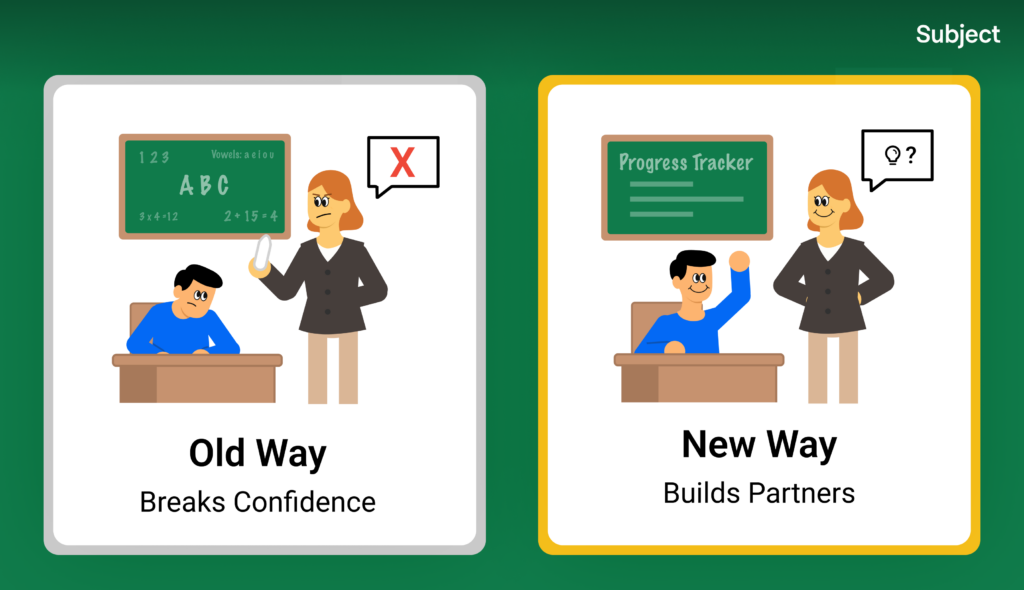
Instead of “right” and “wrong,” she started framing her feedback as “the new way” and “the old way.”
“So, hey, we said the old way, let’s try the new way,” Lucia would tell her students, adding that while some skeptics might brush this off as a “touchy-feely” language choice, it’s simple psychology.
When students see themselves as learners moving toward mastery rather than failure cases being fixed, they engage differently with the learning process. They become partners rather than patients.
The Six Steps to Building Speech Confidence
Lucia’s system is methodical, but thankfully, it isn’t rocket science. Every one of her steps builds on the previous one. So, students can’t skip ahead until they’ve genuinely mastered where they are. The beauty lies in the transparency, where students know exactly what they’re working on, why they’re working on it, and how they’ll know when they’re ready to move up. Most importantly, they become partners in tracking their own progress, rather than passive recipients of adult judgment.
- Step 1: Build Sound Discrimination Skills
Before students can produce correct sounds, they need to hear the difference between their current production and the target sound. “We start small,” Lucia explains. “We always start with them being able to discriminate between the sounds of their speech sound target and the speech sound error.”
She isn’t in a rush. Students learn basic anatomy—where the tongue goes, how lips position, and whether the voice turns on or off. Think of it like learning to drive: you’ve got to understand the mechanics before you can navigate traffic.
- Step 2: Master Isolated Sound Production
Once students can hear the difference, they practice producing the target sound in isolation. No pressure. Or even complex words. It was purely just about getting comfortable with the new sound itself.
“Then we move to them being able to say the sound in isolation, and it’s all depending upon their goal,” Lucia says. “If they reach 80% accuracy, we keep moving on in the hierarchy.” Plus, working towards manageable accuracy goals can help students move towards speech fluency.
The point here is to let students advance based on their individual progress, not enforced timelines. Moving from “the old way” to “the new way” is unique for each student.
- Step 3: Apply Sounds to Words and Sentences
Here’s where things get interesting. Students take their isolated sound mastery and embed it in increasingly complex linguistic contexts:. “After isolation, we go to words. After words, we move to being able to produce those sounds and words at the sentence level.”
But she’s still watching carefully. “There are times when we’ll get to a certain level with a student where they mastered all of their words, but when we get to the sentence level, they struggle,” she adds. “I can just see their confidence just goes right down. So, I don’t keep them there.”
Returning to already-mastered concepts isn’t a failure: it’s an opportunity to work on confidence and then move up the ladder.
- Step 4: Bridge to Academic Content
Lucia’s next step is a crucial bridge towards classroom confidence. She says it’s not too common, but she loves doing it—oral reading.
“It’s more of an oral reading,” she explains. “If I were to put a sentence on the screen or give them a paragraph, I want to know if they’re able to catch the sounds. Or if they’re accessing some of that curriculum material.”
In other words, students practice their speech skills with actual classroom content. While this is still a part of speech practice, the goal for the student here is to prepare for the classroom environment.
- Step 5: Transfer to Real Conversation
Finally, students use their skills in genuine, unscripted conversation. After they do the oral reading, Lucia and her students move to real conversations. “The game ‘Would You Rather?’ would get them to start talking to their peers, or sometimes, they’d even just chat with me about their weekend,” she adds, referring to some prompts she used to get her students talking.
Social conversation builds confidence, too.
- Step 6: Student Partnership and Self-Assessment
Throughout the entire process, students become active partners in tracking their progress. For Lucia’s data collection, she only uses one symbol: +
“I never do minuses,” she adds, citing that if a particular student needs support, she’d just circle the plus sign and add additional notes. “If I ever circle a plus, that just means we did this skill in ‘the old way,’ and we just need help.”
Students love this system, often showing a ton of excitement for future exercises. “They’re like, ‘how many circles did I get? Oh, I’m gonna get two next time!’”
So, instead of battling against arbitrary standards or comparing themselves to classmates, students develop pure growth-mindset thinking. They only see their own opportunities for improvement, never the fixed (and soul-crushing) mindset trap of failure.
From Silence to Book Fair Glory
Students go from communication avoiders to confident participants. Lucia notes that it’s no subtle transformation.
One of her students, for example, wouldn’t talk or engage with others. “Our school has a book fair coming up, where he’s going to have to read in front of a large group,” she recalls. “A couple years ago, that would have been really terrifying for him. But now he’s doing it.”
The proof extends beyond anecdotal success. Recently, she did an articulation screener with her fifth graders, and was able to see how much drastic improvements they’ve made since first grade.
“It was amazing to see that they had no R sounds their first year, and then now, they’ve completely mastered everything.”
But perhaps the most powerful result is the shift in student self-perception. Students were able to develop metacognitive awareness of their own communication development. In the end, becoming advocates for their own learning rather than passive recipients of instruction.
When Lucia shows students their progress from first grade to fifth grade, the response is emotional.
“I had one little student that started getting tears in her eyes,” she recalls. “She’s like, ‘Ms. Donia, I didn’t even know that I was doing this well!’'”
FAQ
How long does this process typically take?
It varies completely by student and goal complexity. Some students master isolated sounds quickly but need months to transfer to conversation. Others move through the early steps rapidly but need extended support for academic integration. What’s important is allowing individual pacing rather than forcing predetermined timelines.
What if a student resists the process or says they like how they sound?
Lucia handles this directly. Some students will simply tell her, “Ms. Donia, I like how I sound. I don’t want to work on speech anymore.” Her response focuses on academic impact rather than speech standards. If the student is understood and their communication isn’t impacting their education or social connections, she works with parents to consider different plans. At the end of the day, student mental and emotional health always comes first.
How do you handle multilingual students whose “errors” are actually language differences?
This requires careful distinction between speech disorders and language influences. A student’s error that you might be hearing is not actually an error in speech sound development. Lucia says it’s based on the language influence, For some, it’ll be their first language influence on English. The goal is educational support, not accent modification. If a sound doesn’t exist in a student’s home language, expecting perfect English production becomes inappropriate and potentially discriminatory.