
EdTech companies love copying the B2B SaaS playbook. Track usage metrics, measure time-on-platform, calculate retention rates, and present quarterly business reviews packed with charts. The numbers do most of the talking.
Won Ko came from that background he joined Subject as Senior Customer Success Manager in mid-2023. Traditional B2B SaaS companies use data to convince engineering leaders to renew contracts. If you saved a company money or improved their metrics, the numbers spoke for themselves.
Education is a bit more human, and therefore complicated.
Won discovered this after two years managing California partnerships while Subject grew through back-to-back record years. But selling to schools requires balancing quantitative platform data with qualitative human stories in ways that would make most SaaS executives uncomfortable.
When Dashboard Metrics Miss the Political Reality
Traditional tech implementation follows a straight line. The person who buys your product leads implementation or a VP of engineering sources a new tool, likes what they see, and rolls it out to their team. The vision already exists for how it fits a workflow.
Education, then, takes the winding way. An assistant superintendent might purchase Subject, but implementation gets passed down through four or five organizational levels before reaching actual classrooms. The executive director of secondary education passes it to the director of instruction, who hands it to the curriculum coordinator, who assigns it to a teacher on special assignment.
“The vision, the ownership, there’s just a lack of clear responsibility and designation,” Won explains. Each handoff dilutes the original purchasing vision. By the time Subject reaches the classroom teacher who’ll actually use it, nobody remembers why the district bought it in the first place.
To add to the ledger, the average tenure of an assistant superintendent is about two or three years. Staff turnover disrupts long-term implementation plans before they can take root. Won might develop a three-year growth strategy with one administrator, only to watch them leave for a new district mid-implementation.
The superintendent to student disconnect creates a bigger problem than lost contracts. When teachers receive a platform they never asked for, with no vision for how it fits their classroom, they can’t employ it effectively for students.
Strong usage data and positive student outcomes require teachers who understand why the technology exists in the first place. Without that foundational vision, districts struggle to implement at all, leaving EdTech companies with empty dashboards and confused explanations for why adoption never happened.
The Two-Track System for Proving Value
Won built his customer success strategy around a dual-track system: quantitative data for the foundation, qualitative relationships for the follow-through.
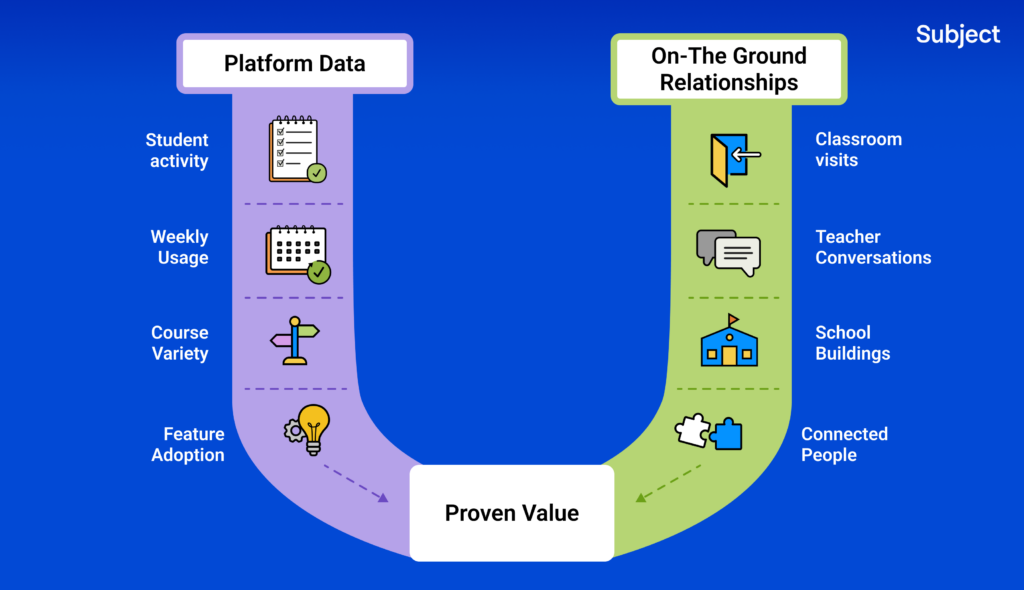
Track one involves standard platform metrics:
- How active are students?
- Are users returning week over week?
- Is there a wide course variety being accessed? Are students using all available features?
Won queries this backend data constantly to build data-driven health assessments.
Track two requires something most SaaS companies avoid: “We put a lot of emphasis on going on-site and really getting on-the-ground feedback,” Won says. These visits help Subject build better products through direct user feedback, and they also reveal the political dynamics and relationship webs that determine whether districts will expand or cancel their contracts.
Subject operates differently than typical EdTech vendors who expect teachers to figure out the system because it was purchased by leadership. Won and his team build relationships across organizational levels and identify likely succession candidates before staff turnover happens. Call it relationship multi-threading.
This dual-track system works because Won can present hard numbers about student engagement while simultaneously converting those numbers into human stories that resonate with district decision-makers. Platform data might show 75% weekly active users, but on-site visits reveal teachers saying “because of Subject, I feel like I’m connecting a lot more with my kids.”
Building Programs That Serve Multiple User Types Simultaneously
The other major difference between B2B SaaS and a district of diverse schools? Multiple competing user profiles with different needs.
“You have to be able to prioritize using context. Do I want to put more eggs in the basket for sub-users, aka the teacher and admin, or do I want to prioritize the experience of our students?”
Most legacy EdTech providers optimize for administrators and teachers because they control purchasing decisions. That’s why so much curriculum “feels like it was made in the 1980s.” Subject takes a different view: student experience matters as much as, if not more than, administrative convenience.
This philosophy shows up in how Won structures district partnerships. At Napa Valley Unified, Subject serves every high school plus two middle schools across seven distinct programs: credit recovery, CTE expansion, independent study, special education, summer school, and EL support.
Creating modular solutions for diverse user groups requires more customization than the typical “here’s our product, figure it out” SaaS sales process. But every school is different, so adaptability is key..
AI Forces Districts to Evolve or Get Left Behind
Won recently sat in on an after-school program where a student got caught cheating, which sparked a classroom discussion. Every single kid admitted to using ChatGPT and Snapchat filters that scan homework problems and return answers instantly.
“If districts don’t evolve with that, you’re going to have a huge imbalance,” Won warns. Students can now bypass traditional curriculum with AI tools and can access unlimited information online, but they still need teachers as their coaches. AI can’t help with social and emotional development, and teachers are crucial for helping kids learn how to use technology responsibly.
“I think teaching is about teaching morals things like accountability and really mentoring based on your previous experience in life.” Won adds. “There’s not really any better people to teach those lessons other than teachers.”
This human element explains why Won’s customer success strategy balances data with relationships. Districts will always need to see both the numbers and the human impact stories.