
How UCLA Lab School’s budget shifts separate schools producing anxious graduates from resilient ones
Two seventh graders sit in the same classroom. Both are smart enough to master pre-algebra and come from families who care about education.
But when a group project goes sideways, Student A (we’ll call them “Frazzled Fran”) spirals into anxiety while Student B (“Grounded Grace”) talks through the conflict and moves on.
Dr. Renata Gusmão-Garcia Williams, a 20-year education veteran, sees this split daily. “There’s so much more anxiety,” the principal of UCLA Lab School says, observing what she dubs “the pandemic generation.”
The difference between these two students isn’t genetics or luck. Student B’s school spent years building emotional regulation infrastructure. Student A’s school figured test scores were enough. Now Student A can pass tests but can’t handle a disagreement with a classmate without falling apart.
Key Takeaways:
- Schools create two types of students based on whether they treat emotional skills as core curriculum or afterthought
- Leaders must reallocate budgets from compliance programs to teacher training and social-emotional infrastructure
- Schools investing now gain 20-year advantages in enrollment, teacher retention, and college placement rates
Same classroom, wildly different outcomes
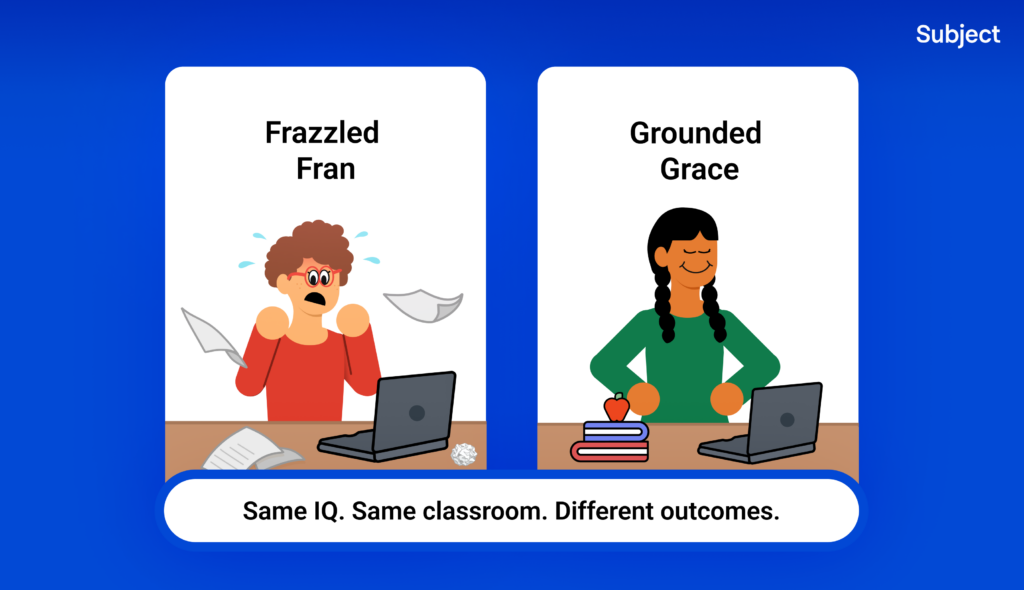
Frazzled Fran and Grounded Grace have identical academic potential.
Same test scores. Same family support. But the split happens because of leadership decisions about what gets funded, measured, and prioritized.
Frazzled Fran’s school operates on compliance logic:
- Pour money into test prep software and intervention programs
- Hire based on content expertise, ignore emotional coaching skills
- Measure success through proficiency rates and discipline referrals
- React to student anxiety with more rules and consequences
Grounded Grace’s school operates on human-centered logic:
- Invest in teacher training for emotional regulation coaching
- Hire educators who can teach both content and life skills
- Track emotional growth alongside academic achievement
- Treat student anxiety as data about missing skills, not bad behavior
The most recent data say 87% of public schools report the pandemic hurt student social-emotional development.
The schools with the worst outcomes never built emotional intelligence into their curriculum in the first place. The pandemic just made the gap impossible to ignore.
“Even households who had strict no-tech rules until eighth grade suddenly had school on the computer—and then socialized on the internet, too,” Renata points out, assessing how 18 months of social isolation ate into critical development years.
Frazzled Fran was 10 years old in March 2020. That’s when kids are supposed to practice navigating conflicts, recovering from rejection, handling disappointment. Instead, Fran spent ages 10-12 interacting through screens where you can just log off when things get uncomfortable.
Grounded Grace’s school understood this gap and built explicit instruction to fill it. Fran’s school reopened, tried to get back to normal, and now has classrooms full of 13-year-olds who fall apart over minor disagreements.
When 79% of schools report needing more mental health support, and 70% need training on social-emotional development, there’s a growing and dire need for schools to actually reallocate resources to address it.
Your annual budget determines which kid you build
The UCLA Lab School functions as an educational laboratory. A place where new teaching methods get tested in real classrooms with real students. For Renata, that means treating social-emotional development as seriously as academic achievement.
“We really are a place that nurtures a child as an entire person, not just checking off boxes about what they learned or what they need to be taught,” Renata adds. “It’s really about more: ‘how are you feeling today?'”
For a school to get to that place requires moving money from programs that look good on paper to investments that actually change outcomes.
Here’s her breakdown of ideal budget reallocation:
⏸ Stop funding: Test prep software boosts scores 3%, but doesn’t teach students how to handle stress. Cut it. Discipline programs that punish anxiety instead of addressing it? Cut those too. Intervention specialists who re-teach content but can’t coach emotional regulation aren’t solving the actual problem.
▶︎ Start funding: Put that money into teacher training on emotional coaching. Hire counselors who can teach conflict resolution methods. Build curriculum time for explicit social-emotional skill building. Get assessment tools that track whether students can recover from setbacks, not just whether they can pass tests.
“Allow them to take risks and to be there. Make mistakes, fall down, get into an argument with a friend,” Renata says, referring to UCLA Lab School’s philosophy. “Have all those things happen in this place where you have all these loving and caring adults.”.
Safe failure is a core curriculum for a generation that missed 18 months of practice. Like learning to ride a bike, except the training wheels are adults who know how to say “You got into a fight with your best friend and now you’re freaking out. Let’s talk about what just happened in your body.”
“You’re creating this little toolbox that you carry with you. So when you’re later on in life and there’s a conflict with your boss or with your partner, you remember that you learn these.”
That toolbox is what separates schools that produce Student As from schools that produce Student Bs. And it requires changing what shows up in your annual budget.
Hire teachers who ask “how are you feeling?”
“I agreed and that’s where I think the evolution of the teacher should be going is like that emotional support that coach,” Renata says.
Fran’s school hires teachers based on content knowledge and test scores, but Grace’s school adds two questions to every interview:
- Can you help a student name what they’re feeling when they’re frustrated?
- Can you coach them through recovering from failure?
When Grace struggles in math, the teacher doesn’t just re-explain fractions. She asks: “You seem stuck. How are you feeling?” Then she helps Grace name the emotion, develop a plan, and push through it.
Fran’s math teacher re-explains the problem three times, gets frustrated, moves on. Fran learns that struggle equals failure. And then goes home and watches 47 TikToks about how school is pointless anyway.
When students can Google any fact in three seconds, teachers need to help kids manage frustration, build persistence, and recover from setbacks.
The schools adopting this philosophy now will retain better teachers. The ones expecting educators to be content robots will keep watching burnout rates climb.
What to tell your school board
When you present this strategic change to your board or superintendent team, frame it around the metrics they actually care about:
- Teacher retention: Schools investing in social-emotional infrastructure keep better educators who aren’t drowning in behavioral crises they were never trained to handle.
- Enrollment: Parents are watching their kids struggle with anxiety. The schools that can honestly say “we teach emotional regulation as deliberately as we teach reading” will win enrollment battles.
- College placement: Universities don’t want Student As who fall apart under pressure. They want Student Bs who can handle roommate conflicts, academic setbacks, and life away from home.
- Long-term outcomes: 65% of Gen Alpha will work in jobs that don’t exist yet. Student A can pass tests but can’t handle stress. Student B can do both. Which graduate do you want representing your school?
Social-emotional learning programs have increased 83% with a dramatic rise in Gen Alpha classrooms. Mental health programs are up 60%. The schools making those investments understand which students actually succeed in college, career, and life. They’re being ruthlessly practical, not soft.
“I think the anxiety does come from not really having experience and time to interact like this,” Renata observes. “These kids have mastered 4-5 hours of daily screen interaction. Face-to-face conversations when stakes are involved? Still working on that one.”
The schools that teach them how (through actual practice, actual mistakes, actual coaching) will lead education in the next 20 years. The ones still optimizing for test scores will keep producing students who look good on paper and fall apart in real life.
Your resource allocation determines which one you become.