
Districts often answer disengagement with tighter rules. Maurissa Koide, a district leader in Silicon Valley, makes the case for building belonging into the schedule instead.
Maurissa Koide‘s sixth grade teacher was named Marianne Engel. Mrs. Engel pushed her into student council, which set her on a leadership track she never left. Decades later, when Koide became a principal, Mrs. Engel was her superintendent. Her daughter is now Koide’s best friend.
Most students don’t get experiences like that. Districts have spent five years answering falling engagement by tightening rules and buying attendance software, but the belonging, community-focused numbers have barely moved.
Maurissa, now Director of Secondary Education at Santa Clara Unified School District, holds a doctorate from USC and wrote her dissertation on restorative practices. Her argument is that disengagement starts as a belonging problem, and no policy has ever produced belonging on its own. A policy can build the conditions for it. That turns what Mrs. Engel did on instinct into something a district does on purpose.
Key takeaways:
- Student disengagement usually starts as a belonging problem, whereas rules and monitoring address the symptom.
- Restorative practice gets mistaken for the absence of consequences, so districts implement half of it and conclude it doesn’t work.
- Belonging that runs on one enthusiastic adult disappears when that adult resigns. Maurissa says there are four levers a district already controls that make it survive.
Most districts hit “restore” from a broken backup
When schools reopened, most districts restored what they had instead of rebuilding it. The systems came back. The students who walked into them did not, at least not the same ones who left.
Maurissa saw the miss in real time. “I thought, ‘okay, this is a perfect opportunity, while we’re shut down, to reset education…’ and the opposite happened,” she explains. “We went back ten thousand steps.”
Chronic absenteeism tells the rest of the story. About 15% of American students missed a tenth of the school year before the pandemic. By 2022 it was 28%, and two years later it had only come down to 24%.
The fix most districts reached for was restorative practice, and then a lot of them decided it didn’t work. Maurissa, however, thinks they never actually ran it. “When people hear restorative practices, they think, ‘oh, nothing’s happening in terms of behavior response,’ which is very much the opposite. It’s really holding the person who caused harm accountable, but it’s really starting with that relationship.”
The relationship half is what often gets cut for time. Without it, restorative practice becomes a conversation between two strangers after something has already gone wrong, which is roughly as effective as it sounds. The version that works runs earlier. “You know when someone is on the verge of having a breakdown, and you can prevent it.”
Knowing a student is also how staff work out what they’re looking at. Maurissa trains her team on Maslow’s Hierarchy of Needs, the pyramid with food and safety holding up the bottom, so they check what’s missing underneath a behavior before they answer the behavior itself.
“If their basic needs are not met and they don’t feel that sense of belonging, they’re never going to be able to get to that critical thinking or retain anything.”
Districts that skip the first half keep paying for the second half forever.
Relationships belong on the master schedule
Every superintendent raises the same fair objection, which is that belonging can’t be mandated. True. A district can still stop leaving it to chance.
Right now, belonging in most systems runs on individual staff going above and beyond, which means it walks out the door with them in June.
Four levers sit inside a district leader’s authority, and none of them require anyone to change their personality:
Time.
Minutes on the master schedule that exist for relationship work and nothing else. Advisory periods repurposed for test prep don’t count, and neither do duty assignments. If a district can’t point to where those minutes live, the initiative is a laminated poster.
Ownership.
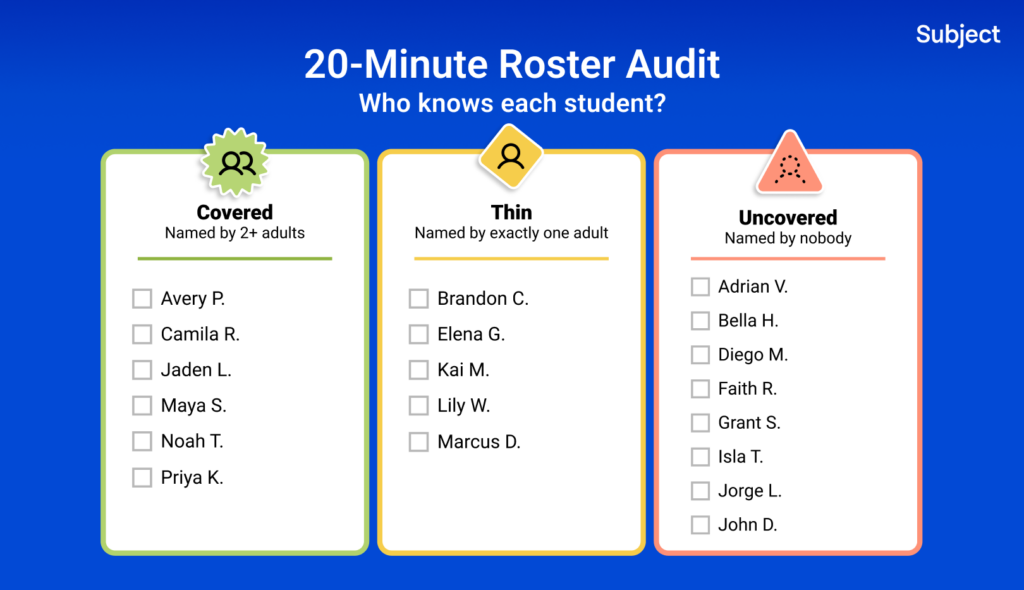
One named adult per student, written down and checkable. Elementary gets this for free because a kid has one teacher. Secondary hands a student six adults and formally assigns none of them.
Contact.
How often a student sees the same adult in a week. Two periods with one person builds more than five split across five. The master schedule is a belonging document that nobody reads as one.
Information.
Whether what one adult notices reaches the next adult. In most districts, the only thing that travels between staff is the referral, which arrives well after it would have been useful.
The CDC has tracked the payoff for years. Students who feel connected at school attend more often and stay enrolled longer, with effects that show up decades later in adulthood. Most districts have no line item for any of it.
Three places belonging gets built
Maurissa’s own path took a while. Ballet, then premed at Columbia, then a medical office, then teaching, then a master’s in public health, then state politics, then teaching again.
She’s also direct about the cost. “How many more years would I have in my education career if I had known in high school that’s what I was meant to do?”
She wants students to reach that clarity sooner with a clear pathway, which is why Milpitas built the Innovation Campus, an extension of Milpitas High with STEM, career technical education and advanced manufacturing tracks. Who fills those seats is a deliberate decision.
“We know that women and our Black and Brown students are not as represented in Silicon Valley,” she adds. “It doesn’t mirror our community.”
A pathway only works if the student walking past it believes the room was built with her in mind.
Family outreach runs on the same logic. Milpitas moved engagement to virtual meetings and online surveys, which was convenient for the district and a closed door for families without reliable internet. “We can’t just assume everyone has a cell phone or knows how to use a QR code.”
The last piece is the classroom. Maurissa still walks into rooms where one adult lectures from the front, which she describes as the sage on the stage. Her ask is smaller than it sounds. “There has to be humility and humanity in what we do.” She proved the point mid-interview by blanking on Maslow’s name, then telling the host to leave it in.
Four beliefs worth writing down
Belonging work is the easiest thing on a district calendar to cancel, because nothing breaks the day you cancel it. The bill arrives two years later in referrals and empty seats. Four decisions make it harder to cancel.
Not one of Maurissa’s four levers for belonging survives on good intentions. It survives on decisions somebody wrote down, funded and still checked on in March, when the calendar is full and everybody is tired.
Here are four worth putting in the cabinet notes:
- A relationship that depends on one enthusiastic adult is a single point of failure. Your IT director would never accept that architecture. Neither should you.
- Behavior is a readout, not defiance. Staff trained to ask what changed catch problems earlier and more humanely than staff trained to consult a chart.
- Restoring a system after a disruption is a decision with a cost. Most districts made it in 2021 without noticing they were making it.
- Representation is an enrollment strategy. Pathways built without deliberate outreach will mirror the demographics of your existing advanced courses.
Mrs. Engel never had a plan for Maurissa. She had a sixth grader who looked like she could run something, a nudge toward student council and about forty years of paying attention after that.
Districts can’t schedule luck, but they can stop depending on it. Build the minutes, name the adults, keep them in the same room, move what they notice, and a lot more kids get a Mrs. Engel on purpose.
FAQs
What is a belonging problem in a school district?
A belonging problem is disengagement caused by students not feeling known or valued by adults at school. It shows up as absenteeism, referrals and dropping participation, which is why districts often misread it as a discipline problem and respond with rules that don’t touch the cause.
Does restorative practice mean no consequences?
No. Restorative practice holds the person who caused harm accountable and starts that process from an existing relationship. Districts that remove the accountability step aren’t running restorative practice, they’re running nothing and calling it something.
How can a district build belonging without new funding?
Start with the master schedule. Protected relationship time, one named adult per student, repeated contact with the same adult and a way for staff observations to travel are all schedule and process decisions rather than budget line items.
Why does student engagement drop in middle school?
Two structures change at once. Students move from one teacher who knows them to six who each know a fraction, and families are told to step back and give kids more independence. The student loses their known adult at school and their most involved adult at home in the same year.