
Spot hidden struggles in top performers before they crack under the pressure
“I will kick you off this team if this isn’t improved next semester.”
Tim Clary thought he understood pressure until his college football coach delivered that ultimatum after a terrible academic semester. Instead of crushing Tim’s confidence, that conversation became the foundation for everything he learned about supporting high-performing students. He chose to increase support while maintaining standards, rather than lower expectations.
And according to Tim, it worked:
“I specifically needed someone who actually saw me, right? That I was more than just a name on a depth chart.”
Now an Account Executive at Subject (and telling everyone on LinkedIn that we need to pay teachers more), Tim has translated his walk-on experience and coaching years into educator team support.
To give students the emotional support they need, asking questions about how you approach supporting students will help coaches and teachers identify what each athlete actually needs. Beyond performance metrics, it’s on the coach to create an environment where students see a pathway to their goals.
Key Takeaways
- Student-athletes who appear strongest often struggle the most because their competitiveness prevents them from showing vulnerability
- High performance requires high emotional support—challenge without safety breaks students, support without challenge fails to build resilience
- The 4 essential questions can help coaches and teachers identify what each student-athlete actually needs beyond athletic performance
Strong Kids, Silent Struggles
91% of high school athletes experience sports-related stress. If we want to get nitty-gritty with it, about 58% report moderate to extreme levels.
Among college athletes, 22.3% are at risk for depression, and nearly 65% report elevated anxiety levels. What the statistics miss is that some athletes may hide their struggles completely.
Clary discovered this firsthand when his college coach confronted him about poor grades. He walked onto a Division 1 team, overwhelmed but excited. Gratitude mixed with fear created a toxic combination—he felt he had to prove his worth constantly while maintaining the façade that everything was under control.
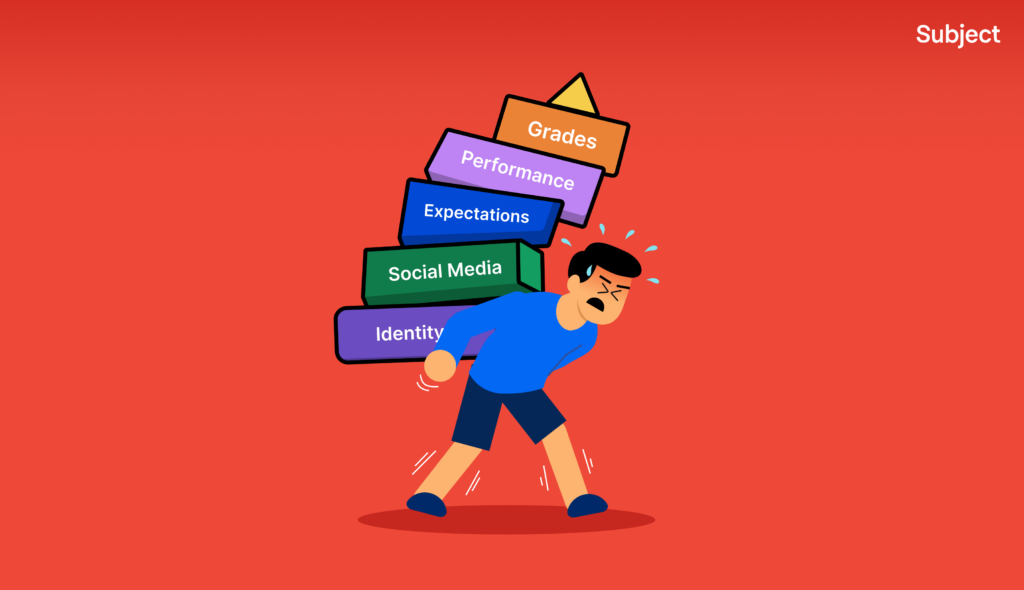
“What often gets missed was how mentally exhausting it is to balance school, and workouts, and film, and travel, and the expectation to perform,” Tim explains. “People assume toughness and the ability to do that equaled invincibility. Being a student athlete is fragile.”
The problem gets worse with success. Star athletes learn early that showing weakness threatens their position, their scholarships, their identity.
How to Read Your Star Students
When his coach raised support while maintaining the standards, it taught Tim a crucial lesson that he later applied as a coach himself:
Challenge without support breaks students.
Support without challenge fails to develop resilience.
For athletes specifically, Tim made sure his stance was clear: “I have high expectations for you, because I’m giving you the support that you need to achieve those expectations.”
He wasn’t being nice or going easy. Tim says he was just creating psychological safety within high-performance environments. Student athletes don’t want an easy experience: they’re high-achieves. However, when athletes know they can ask for help without judgment, they’re more likely to address problems before they become crises.
Tim learned to ask himself four questions to uncover what support each student-athlete needs:
Question 1: What is this person’s story beyond their sport?
When Tim was a student, he needed someone who actually saw him more than just a name on a depth chart. “When I first walked on, you’re a nobody,” he recalls. “People don’t know your name, they’re just a moving blocking bag, so to speak.”
Ask yourself: What pressures are they carrying outside of the field? What are their dreams? What makes them feel invisible or seen? Students can’t trust you with their struggles until they know you see them as complete people.
Question 2: Can this person ask me for help without feeling like they’ll lose respect?
“I wanted students to know they could ask me for help without being judged,” Tim explains. That feeling of safety means students will be proactive about their own goals, and trust that their coach (or teacher) will help them achieve. Acting as a calm sounding board is crucial when students come to you with questions.
When athletes make mistakes, do you react with disappointment or curiosity? Do they see you as safe to reach with problems? Student-athletes are conditioned to hide weakness, but it’s your job to actively create psychological safety for authentic communication.
Question 3: What life skills am I modeling and teaching beyond technique?
Upon reflection, Tim wishes he had someone who taught him how to fail productively, and how to separate his identity from performance. “It’s rare that they actually get coached on emotional processing.”
So, consider the facts. Are you helping them separate who they are from what they do? Athletic careers end, but emotional resilience and identity security last a lifetime.
Question 4: How am I responding to their setbacks and struggles?
For Tim’s students, he didn’t want to treat moments of weakness or struggle as what they were. Instead, he treated them as data points, like, ‘hey, we’re gonna learn from this. And this is how we’re going to do it.”
So, finally, begin to self-reflect with these starting points: Do you treat their struggles as character flaws or learning opportunities? Are you helping them reframe pressure as preparation? Your reaction to their failures teaches them whether vulnerability leads to growth or shame.
The Stakes Just Got Higher
We’re witnessing a critical moment for student athletics. With NIL deals now creating six-figure pressures for high school prospects and social media amplifying every performance, the mental health stakes have never been higher. The traditional “tough love” coaching model is cracking under modern pressures that previous generations never faced.
Meanwhile, a broader cultural shift is forcing athletics to reckon with mental health. From Simone Biles stepping back at the Olympics to Naomi Osaka prioritizing wellness over competition, elite athletes are modeling vulnerability as strength. This creates an opportunity for high school and college programs to get ahead of the curve.
Programs that learn to support athletes emotionally—not just physically and tactically—will have the stay in the lead with recruitment, retention, and performance. Athletes gravitate toward environments where they can be human while pursuing excellence.
Four Principles to Help Anyone Excel
After digging deeper with your four questions, you’re ready to help students push even further towards success. We’ve seen for decades that growth happens with the psychological safety of mentorship, and students are able to push themselves in their Zone of Proximal Development (as defined by Lev Vygotsky).
Whether you’re coaching football or teaching calculus, these principles help any adult support high-performing students:
- Lead with psychological safety, not lower standards. Create environments where students can ask for help without losing respect. This means responding to struggles with curiosity rather than disappointment, and treating mistakes as data points rather than character flaws.
- See the person before the performer. Learn their stories, pressures, and dreams beyond their role on your team or in your classroom. When students feel seen as complete humans, they’re more likely to trust you with their real struggles.
- Teach identity security alongside skill development. Help students separate who they are from what they do. This involves explicitly coaching emotional processing skills, not just assuming they’ll figure it out.
- Match your support level to your expectations. The higher your performance standards, the more emotional scaffolding you must provide. Challenge without support breaks students; support without challenge fails to build resilience.
These principles work because they address what research consistently shows: high-achieving students often struggle the most, not despite their success, but because of the pressures that create it. While eliminating pressure is certainly a plus, the goal is to help students process it productively while maintaining their humanity.