
A guide to saying yes to a CTE pathway or curriculum adoption without a month of late nights.
Zeke Ramirez once flew to our Los Angeles office to help with a math course. By the end of the week, he was in a lab coat and goggles, reading a script for a science lab video. Stories like that are a blast at Subject holiday parties but a tough way to run a district office.
Zeke is Subject’s STEM Curriculum Strategy Manager and a former math teacher in Washington, D.C., and Texas, and he holds a Master of Education. Vanessa Calkins taught writing at the University of Central Florida for almost 13 years and is now our Senior Manager, Education Operations. Both have pulled their share of deadline saves, and both now build the habits that replace them.
“We’re trying to rely less on heroics of people pushing courses out at 3 a.m. and more on new people processes that are predictable,” Zeke says.
Their fix works like a loop, and it’s built for any district office staring down its next big rollout.
Key takeaways:
- Subject’s Zeke Ramirez and Vanessa Calkins say teams that run on all-nighters keep their process in a few heads, which limits what they take on.
- District teams that talk through and write down recurring jobs free up time to launch new programs.
- Before saying yes to a big project, district leaders should name one owner and check whether the plan is one course or really four.
Deadline heroes can’t carry a district
Every district has its legends. There’s the curriculum director who finished the pacing guides at 2 a.m. before in-service, and there’s the assistant principal who is somehow the only person alive who knows how testing accommodations get set up. Most leaders look at those people and see a great team.
Zeke gets the appeal.
“When you work until midnight with somebody three nights a week, when you do the 3 a.m., ‘hey, submit, there’s something there’, you create a trauma bond.”
The catch shows up when the team grows. Vanessa found “a pocket of people over here doing one thing and another pocket of people over here doing a very similar thing,” with neither pocket aware of the other. The steps for common jobs lived “in different people’s heads in different ways,” and nobody had written them down.
“If you bake a cake two different ways, it’s going to come out two different ways,” she adds.
In a district, that looks like two middle schools writing two versions of the same 7th-grade math unit. (Somewhere, a parent with kids at both schools is very confused about fractions.) The skill Zeke and Vanessa lean on is less glamorous than a midnight save. They talk the steps out before writing them down, and the time they get back goes to bigger work.
How “The Yes Cycle” turns scrambles into routines
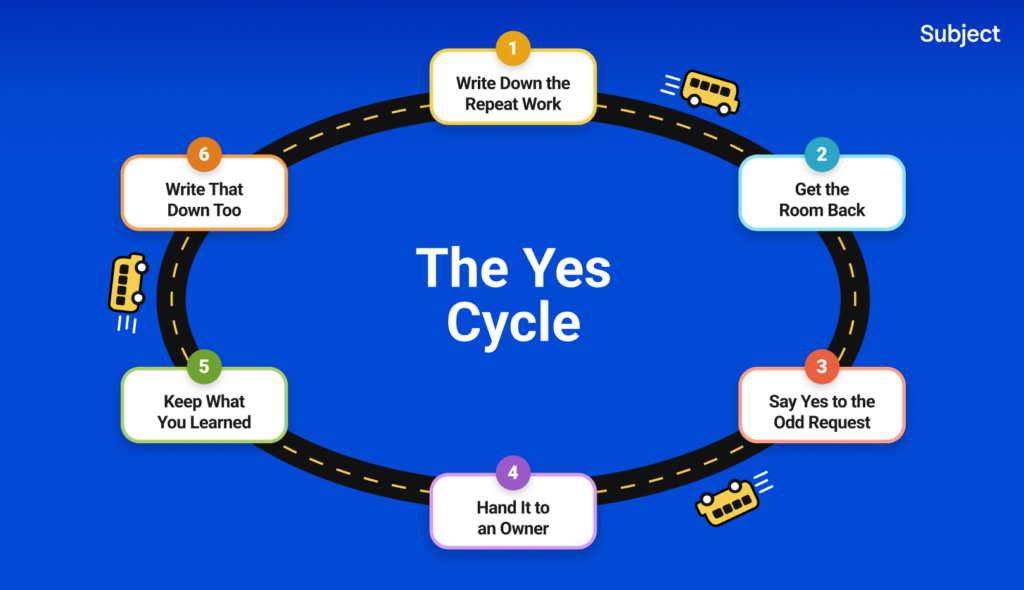
The Yes Cycle has six stages. Each lap turns a one-time scramble into a routine, and the routine frees up room for the next big project.
Stage 1: Write down the repeat work
Vanessa started by putting people in the same room. Leaders working on math content now meet “at least once a week for 30 minutes” to check on projects and clear blockers. Those meetings are where the steps finally get said out loud, and they make the process a lot more visible and collaborative. “There’s a lot of talking and listening,” she says.
For a district, start with the jobs that come back every year, like the master schedule or new-teacher onboarding. Think of it as Groundhog Day, except this time somebody takes notes.
Stage 2: Get the room back
Once a yearly job lives on paper, it stops needing a hero. The night before in-service turns into a regular Tuesday, and the hours the team used to spend scrambling become hours it can spend on something new.
Stage 3: Say “yes” to the odd request
Zeke says the team now takes on custom requests “regardless of the size of the partner.” That wasn’t always true. “Two years ago, we would just say, ‘hey, sorry, we’ll do better next year,’” he says. “But this time, we bootstrapped it, and then we made it happen.”
Districts get odd requests too, like a new virtual option, a CTE pathway, a curriculum adoption or a teacher’s passion elective. The trick is keeping each yes a reasonable size.
The Four-Course Problem
Vanessa once inherited an art history course that had been scoped for about a year, which in Subject time “might as well have been a decade.” Once the team started building, “it was really more like four courses.” Her job was “wanting to keep that vision central, but also needing to make it right-sized in terms of what we could actually do.”
- Find the vision. Name the one thing the creator would fight for, and protect it.
- Count the real size. Check whether the proposal is one course or four courses wearing a trench coat.
- Build this year’s version. Make the version that fits your calendar and the people you actually have.
- Park the sequel. This step is our suggestion. Write down what got cut so it has a home next year and its creator knows it’s on deck.
Stage 4: Hand it to an owner
Unusual projects need “very strong project management,” Zeke says. For his team, Vanessa filled that role. “She is someone who is comfortable putting together a stand-up and really speaking to any kind of ambiguities and resolving them with the right people,” he says. (A stand-up is a short, regular check-in.)
Before a district says yes to a new program, it helps to name the one person who will run it. A project owned by “everyone” is usually owned by no one.
Stage 5: Keep what you learned
Every big yes teaches the team something. Vanessa’s new role is built on that, and she describes it as using “all the things that we fixed and broke along the way and what worked and didn’t to really make a good standard of practice.”
Stage 6: Write that down too
Then the loop starts over. Zeke’s Texas test prep courses were “the kind of thing that we used to say no to,” he says. “But now we’re building it.” Each odd project becomes next year’s routine project, so the list of things a team can say yes to keeps getting longer.
More “yes” is headed your way
Districts are about to get a lot more odd requests. K-12 CTE enrollment rose 10% between the 2022-23 and 2023-24 school years, according to the Center for American Progress. Michigan alone reports a 44% jump in state-approved CTE programs over the last decade.
Every new pathway is a project somebody has to run.
The people who hold the steps also move on. District leaders told RAND that principal turnover sat around 8% in 2024-25, with teacher turnover a little under 7%. When the only copy of a process lives in one head, it can leave in June with a cake and a card.
The timelines keep moving as well. “What a timeline looked like two years ago is totally different than now,” Vanessa says.
The good news is that structure makes room for the fun parts of the job. Zeke now blocks time on his calendar for the work he loves most.
“I book 30 minutes a day to just screw around and make math games,” he says. “Engagement is still the most important thing for the education team.”
Write down the boring stuff, and your team gets its nights back for the good stuff.
Say yes to that new CTE pathway without a summer of late nights. See how Subject’s course catalog gives your team a running start.
FAQs
How can district curriculum teams take on bigger projects without all-nighters?
District curriculum teams take on bigger projects by writing down the steps for recurring jobs and meeting weekly by subject area. Subject’s Zeke Ramirez and Vanessa Calkins say written steps replace 3 a.m. saves and free up time for new programs.
What is the Yes Cycle?
The Yes Cycle is a six-stage loop for growing a team’s capacity, drawn from Subject’s education team. Teams write down repeat work, get time back, say yes to odd requests, name an owner, keep what they learned and write that down too.
How do you keep a passion elective from growing too big?
A passion elective stays a manageable size when leaders protect the creator’s core vision and cut the rest to fit one school year. Vanessa Calkins used this on an art history course at Subject that turned out to be “really more like four courses.”
Why should school districts write down recurring processes?
School districts should write down recurring processes because staff turnover takes undocumented steps out the door. RAND estimates principal turnover was about 8% in 2024-25. A written process for jobs like the master schedule lets new staff pick up the work.