
The collaborative grading process that works across all skill levels and learning needs
How do you grade art?
Every art teacher hears this question, usually followed by some variation of “Isn’t it all subjective?” The question itself underlines the real problem: We’re obsessed with judging finished products instead of understanding creative processes.
That’s the crux of the issue when it comes to grading. Traditional art education forces teachers into the same impossible dilemma: grade on pure skill (goodbye, confidence for most students) or give everyone participation trophies (goodbye, any actual standards).
Jette Crow, a visual arts educator currently teaching at Foothill High School, uses a five-category rubric system that lets every student find their path to success.
“I never grade strictly on skill or strictly on creativity,” she says. “There’s a big balance going on, so that everyone can find success.”
Key Takeaways:
- Five categories create multiple paths to success for different student strengths
- Self-assessment builds communication skills while reducing grading anxiety
- System works for mixed-ability classes from struggling to advanced students
How Traditional Grading Kills Confidence
When Jette faces her mixed-age drawing and painting classes with students ranging from 13 to 19 years old, traditional skill-based grading can accidentally sort kids into winners and losers. With 90 of her 200 students having 504 plans or IEPs, the grading system focuses on final product and ignores more process-based factors like effort, creativity, and overall growth.
The result looks a lot like a classroom under a storm cloud. Students without innate artistic ability check out mentally before they’ve even picked up a brush. Not only is their creativity crushed, so is their confidence. Teachers spend more time managing behavioral issues from disengaged students than encouraging creative exploration.
To overcome this, Jette had to ensure accessibility became central to her lesson plans. “I have such a wide variety of skill level all in one class for drawing and painting,” Jette says. “I’ve really had to learn how to break down every step, and make every part of the project accessible.”
Why One Size Never Fits All
Jette’s breakthrough came from recognizing that success in arts education should measure the whole student— effort, creativity, communication skills, and technical growth — rather than just raw talent. Her system acknowledges that students bring different strengths to the classroom and should have various ways to demonstrate mastery.
“I never grade strictly on skill or creativity. There’s a big balance going on, so that everyone can find success.”
Unlike schools that trap students in rigid hierarchies based on innate ability, Jette’s five-category grading rubric creates genuine opportunities for every student to excel through their unique combination of strengths.
Grade For Growth
Jette’s evaluation process takes traditional assessment and turns it into a collaborative learning experience.
She follows four steps to balance structure with flexibility, ensuring clear expectations while honoring student voice and individual growth patterns. Each step builds naturally into the next, creating a feedback loop where students become active participants in their own evaluation rather than passive recipients of grades.
Oh, and it works across diverse learning needs and skill levels.
Here’s how to use her grading system:
- Step 1: Design the Five-Category Rubric
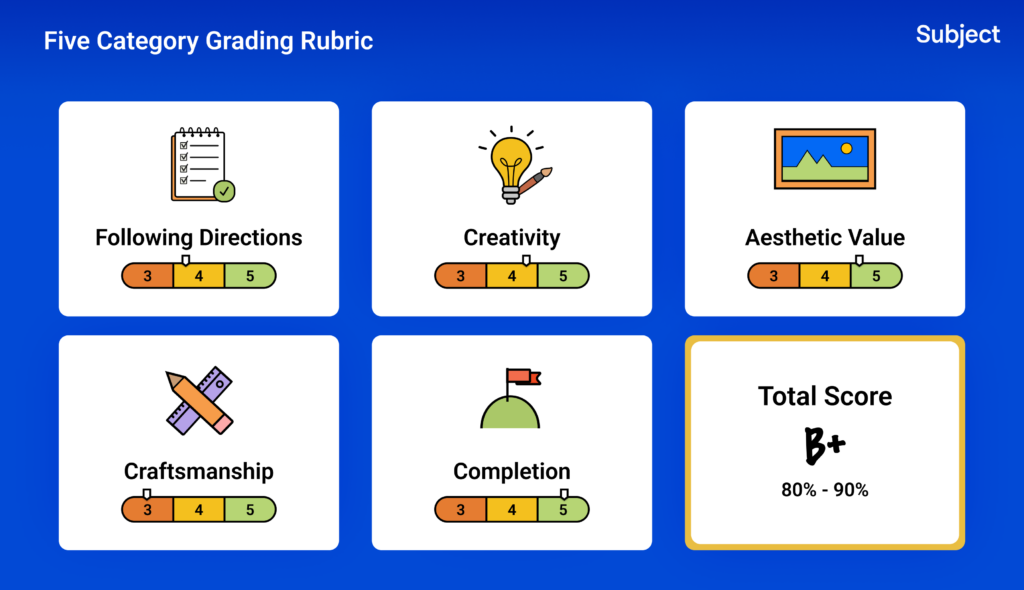
Jette structures every assignment around five distinct categories:
- Following directions (with 5 specific bullet points per project)
- Creativity
- Aesthetic value
- Craftsmanship/technique
- Progress toward completion
Each category uses a 3-5 point scale where 3 represents average work, 4 is good, and 5 is exceptional.
This structure means students can excel in different areas. “Most kids work really hard,” she adds. “They are creative. They do follow most of the directions. Even if a student struggles with technical skills, they can score low there and high everywhere else and end up with an A- or B+.”
- Step 2: Set Crystal-Clear Expectations
Every assignment includes five specific, measurable bullet points for the “following directions” category. For a still-life drawing, this might include “make sure there’s a cast shadow” or “avoid harsh outlines.” These concrete expectations eliminate grading mystery and reduce student anxiety about unknown standards.
Specific criteria alongside more subjective creativity measures ensures students understand exactly what constitutes success in each category before they begin working.
- Step 3: Require Student Self-Assessment
Students complete the entire rubric for themselves before Jette reviews their work. This is a required step that builds accountability and honest self-reflection.
This step naturally incorporates multiple academic skills: written communication, basic math (calculating percentages), and figuring out how to stand behind their self-evaluation.
- Step 4: Conduct 1:1 Chats on Assessment with Students
Using each student’s self-assessment as a starting point, Jette has face-to-face conversations about their work. These discussions allow for real-time feedback, expectation clarification, and relationship-building that can’t happen through written comments alone.
“We have our little quick conversation,” she explains. “That way if they say ‘I deserve a 72%’, they usually don’t. That’s because they usually deserve a grade a little higher.” Artists are their own worst critics.
Through these meaningful one-on-one meetings, students learn to articulate their creative process and accept constructive feedback.
Beyond Grades: Skills for Life
When assessment becomes collaborative rather than punitive, the classroom transforms.
Students stop fearing evaluation and start embracing it as a tool for growth. Teachers reclaim their role as mentors rather than taste gatekeepers, spending energy on instruction instead of behavior management.
Here’s what happens when teachers and districts adopt her five-category rubric system:
- Academic Success Across All Skill Levels
Jette’s system creates genuine equity, where students with different strengths can both achieve high grades through distinct pathways. A highly creative rule-breaker and a methodical, but less innovative student can both earn A’s by excelling in different categories. “If a student’s crazy creative and they break the rules and don’t follow the directions, they can still get an A, because it balances.” - Enhanced Communication and Literacy Skills
The self-assessment and conversation components naturally build competencies across disciplines. “It’s incredible for the literacy component of education,” Jette notes, citing that it’s because they’re speaking with her directly—advocating for what they’ve done or not done for the projects and assignments. - Reduced Anxiety and Increased Engagement
Students understand exactly what’s expected and how they can succeed, eliminating “the anxiety of the unknown” around grading. This transparency creates a classroom culture where everyone can achieve success through their particular strengths.
The system also builds what Jette calls “loving accountability.” It’s when students honestly evaluate their effort and participation because they understand the standards and feel heard in the assessment process.
Jette’s five-category grading framework transforms art class from a talent competition into a growth environment where technical skill, creative thinking, work ethic, and communication abilities all contribute to student success. In Jette’s case, students leave not just with improved artistic abilities, but with stronger self-advocacy skills and confidence in their capacity to meet clear expectations through sustained effort.
What could be more rewarding to a teacher?