
Why forcing all students through identical creative processes is like making everyone wear size 8 shoes
Art class should be the one place where mess equals magic, but schools treat creativity like factory work.
Students move through stations with identical supplies, creating nearly identical projects that could hang in any hallway across America. Schools keep forcing everyone through the same creative assembly line, handing them all the same pencil, and wondering why creativity looks like standardized testing.
Lindsey Sherrard realized maybe the problem isn’t the kids.
It’s the pencils.
With more than 10 years teaching visual arts from kindergarten through 12th grade across charter schools, public schools, and online platforms, she’s seen students embrace a variety of artistic tools and mediums. She’s currently helping students with credit recovery and developing content for Subject, which means she’s learned how to meet students where they are.
“What’s interesting about arts education is that we tend to get a good mix of diverse learners in the classroom,” Lindsey says. “I’ve noticed that it’s great to offer different ways to complete the lesson. That way you’re challenging your advanced learners, but you’re also meeting students who need to work on the foundations for that lesson.”
Key Takeaways
- Check skills first, then give projects: Use basic activities to see how students handle different materials before deciding what projects they should do.
- Match materials to what works: Students who struggle with small pencils do great with clay, while detail-loving students shine with precise drawing tools. Same learning goals, different paths.
- Change how you teach based on materials: Online clay projects need different instructions than in-person drawing, but both encourage creative thinking.
Why One Size Fits Nobody
Art teachers face a tricky puzzle. You’ve got students with different hand skills, different attention spans, different tech abilities, and completely different ways of learning, all in the same room (or video call). Some kids are great with tiny detailed work, while others need materials they can grab with their whole hands.
The myth of equal supplies runs deep in education. Years of teaching toward standardized tests created a school culture obsessed with uniform results. Art class doesn’t have state testing breathing down its neck, but the assembly-line thinking still shows up. We give every student the same materials and call it fairness, then act surprised when some thrive and others barely engage.
The challenge gets trickier when you factor in different learning environments. What works in a regular classroom doesn’t automatically work for online learning. What gets one group of students excited might completely lose another group. Teachers need to keep up with education standards while somehow making everyone successful, often without enough time to really understand how each student learns best.
“When you get a new group of kids, you really want to see where their skills are and where they’re coming from,” Lindsey notes.
The old way of making all students do the same creative work assumes that students won’t get discouraged by skills that don’t engage them, and will easily move onto the next unit. Anyone who’s spent five minutes in a real classroom knows that’s not true.
Matching Brains to Brushes
Instead of forcing students through standard units to produce the same form of creative work, Lindsey found that success comes from medium-matching. In other words, matching art materials with how students naturally learn.
True equity in art education means asking: what tools does each student actually need to create something they’re proud of?
“I’ve seen students who don’t like drawing because their hand skills aren’t great with tiny objects like pencils. They have messy handwriting, but if I give them clay to work with—something they can grab better—they do really well in that area.”
This matching system sits between strict lesson plans and completely free creative time. Students still learn the same things, but they get there through paths that actually work with their brains instead of against them.
How to Ditch the Guesswork
The standardized art paradox is real: we demand creative risk-taking, then measure it with rubrics that reward conformity. It’s the same as telling students to “think outside the box,” and then grade them on how well they color inside it. That mixed message can make creativity feel impossible.
Lindsey’s medium-matching process helps students meet learning goals without teachers forcing them all to follow the same path.
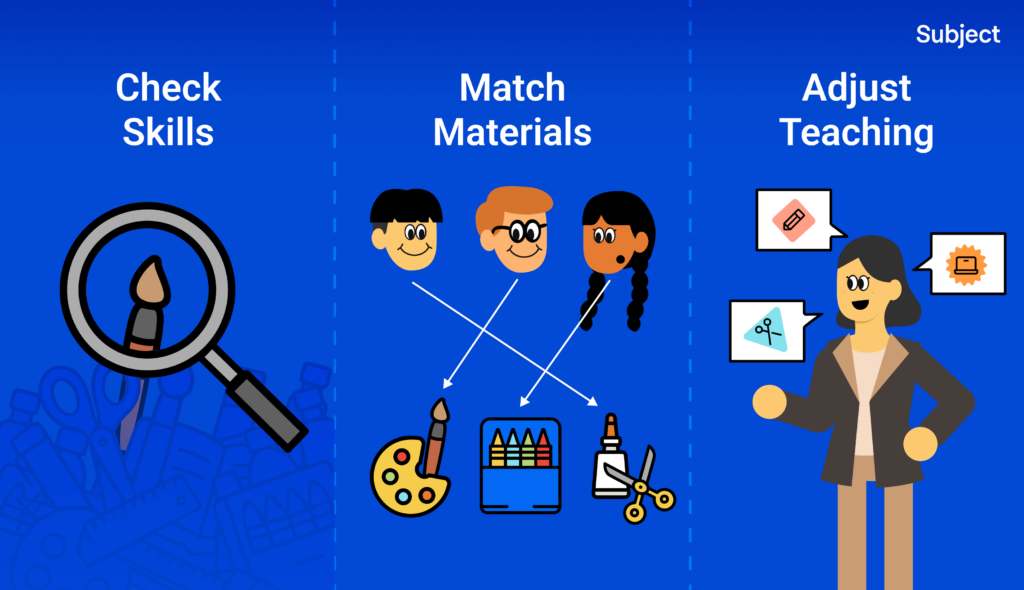
Step 1: Check Basic Skills Through Simple Activities
Before you can match students to the right materials, you need to know what you’re working with. Lindsey uses basic skill-building activities to watch how students work, rather than trusting old grades or guessing.
“We start with a scaffolding technique. We always start with teaching and practicing the basics for that concept we’re covering in the lesson,” she explains. “Once I feel that the class or student understands and can show they’ve learned that idea, that’s when we go into the art-making.”
This watching period shows which students struggle with small hand movements, pattern work, or seeing how shapes fit together. When you ask a student what art they like to make, they may not have an answer, especially if they’ve never tried before. Getting into the making process lets you see what artistic medium lights up a student.
Step 2: Match Students to Materials That Work for Them
Once you understand each student’s natural strengths, offer different project choices within the same lesson. Students who are good at math patterns might choose detailed work like mandalas, while those who struggle with small hand movements work with clay or 3D materials.
Lindsey gives students choice within structure.
“Students who wanted to draw something in one-point perspective like a room—which is much harder—naturally went right for that because they were interested in it,” she adds. “Students who found this was a new concept and weren’t very confident in their skills might pick something simpler, like a landscape.”
The magic happens when students choose for themselves based on their comfort and challenge level. Advanced students push themselves with harder projects, while students building basic skills choose options that let them succeed while still learning the same things. And both final works are beautiful in their own way. The artistic choice lets students explore their zone of genius without necessarily feeling “outdone” by another student.
Step 3: Change How You Teach Based on Materials and Setting
With students working with materials that fit them, change your teaching methods based on whether they’re using digital tools, clay, drawing materials, or 3D building. Online classes need detailed written instructions with pictures, while hands-on materials need you to show them and give quick feedback.
Keep the same rules (like tool safety) while changing how you teach, matching what materials students are using. A student working with clay needs different safety reminders than someone using digital drawing tools, but both need to understand how to use their tools properly.
“Art standards have a lot of wiggle room,” the art teacher says. “Let’s say one of the art standards is practicing tools and materials safely. I can talk about that with different drawing tools, different clay tools, different painting tools.”
Achieve Standards Without Suffering
When students work within mediums that match their natural learning strengths, several magical things can happen.
First, they demonstrate genuine pride in their work, leading to intrinsic motivation rather than compliance-based participation.
Lindsey says one of the greatest privileges of being an art teacher is seeing students succeed in their matched mediums.
“That’s my favorite part. So, I would say, am I ever surprised? Every day, but it’s more of a feeling of, ‘I’m so happy you figured it out,’ or ‘I’m so happy you made this.’”
Students also meet equivalent learning standards through different creative outputs, while teachers maintain curriculum compliance. A student working with acrylic and another student building wire sculptures can both demonstrate understanding of color theory, composition, or cultural art concepts—they just show it through different mediums.
Finally, students working in aligned mediums require less intensive intervention from teachers. When kids are working with materials that match their capabilities, they spend more time creating and less time struggling with tools that don’t work for their hands or brains. Teachers can focus on instruction and skill development instead of managing frustration or behavioral issues.
In the end, teaching art isn’t about supplies. It’s really about the art of translation. Lindsey’s success comes from recognizing that every student speaks a different creative language, and the teacher’s job is simply to listen and understand. When we stop trying to force every student into the same creative box and start meeting them where their hands and minds actually work best, students don’t just make art—they become artists.
FAQs on Medium-Matching
What if I don’t have budget for multiple mediums?
Start with what you have. “Everybody’s got a pencil and paper somewhere,” Lindsey notes. “There are a lot of different websites, or just different digital things that we can use.” Free digital tools like SculptGL can serve students who want to try 3D manipulation, while traditional drawing materials work for detail-oriented learners.
How do I maintain consistent assessment across different mediums?
Focus on the learning standard rather than the specific output. Whether a student demonstrates understanding of pattern through a mandala drawing or a clay sculpture, they’re meeting the same educational goal. Document how each student shows mastery of concepts through their chosen medium.
Can this work in virtual learning environments?
Absolutely. Lindsey explains: “It’s the same thing. I can see what they’ve made, and I can see where they’re understanding concepts, or where we need to go back and just kind of tweak things.” Virtual learning actually makes it easier to offer digital artistic medium options while students use available materials at home.