
Why cutting art programs hurts test scores, and how smart districts invest in art education to boost student success.
Did you know that only 3.2% of the United States education budget is dedicated to the arts?
But every 10 years, 20% of schools reduce their arts offerings. Meanwhile, the global entertainment industry that relies on visual creativity is worth over $2 trillion, and expected to skyrocket to 3.5 trillion in 2009.
How are we preparing kids to be creative thinkers for an economy that places so much value in those skills?
Lindsey Sherrard, a visual arts teacher for our online schools, worries about the reduction of arts budgets: districts should not systematically defund the pipeline that creates everything students actually want to consume.
She’s spent over a decade teaching visual arts from kindergarten through high school..Through her experience collaborating with other teachers and watching students grow, she’s arrived at the conclusion that arts education isn’t at odds with academic achievement.
It’s just the thing that drives it.
Key Takeaways:
- Visual arts classes increase student attendance and participation across all subjects, with students frequently citing art projects as their most memorable school experiences
- Schools maintain quality arts programs during budget cuts by using free digital tools and designing projects that teach multiple subjects simultaneously
- Arts classes prepare students for jobs in growing industries like graphic design, marketing, and digital media that don’t always require college degrees but value strong portfolios
The backwards math of budget cuts
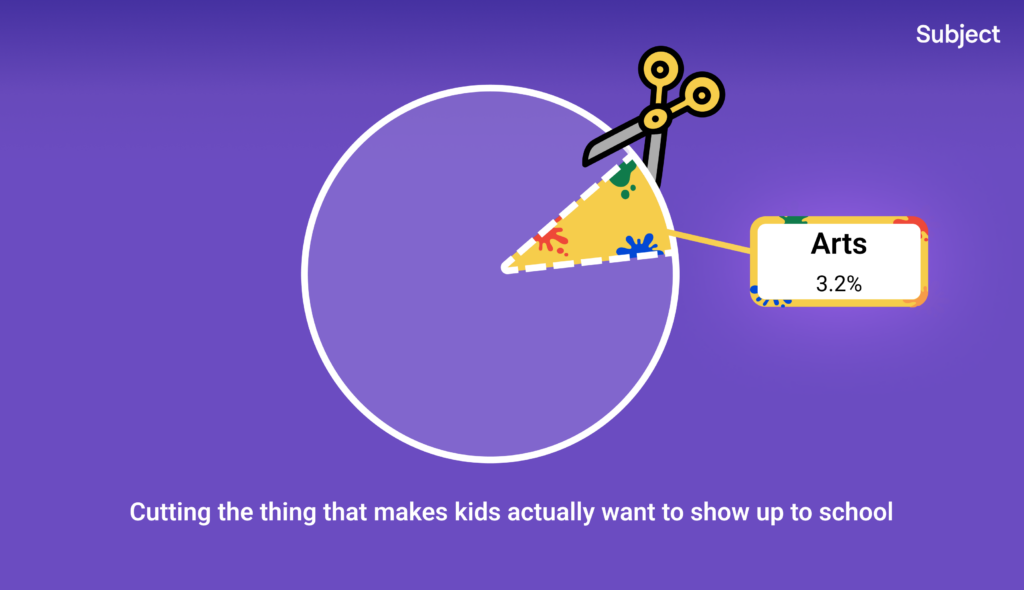
Schools keep treating visual arts like a subscription to the New Yorker—nice to have, but the first thing cut when money gets tight.
Since COVID-era federal funds dried up, states are once again questioning the value of arts in education, with arts offerings for half of K-5 students reduced to zero in major districts like Los Angeles, while districts facing fiscal cliffs are announcing unprecedented job cuts and program eliminations.
Meanwhile, administrators miss the core insight that Lindsey learned through teaching across every grade level:
“A lot of times when I ask students about their day, they tell me something they learned about in art.”
Art classes create the kind of excitement about school that spreads to every classroom. When students get genuinely engaged through art projects, that enthusiasm becomes something all teachers can tap into through collaboration and connection.
The stakes extend beyond test scores. While districts gut arts programs, they inadvertently end up losing one of the few tools most capable of solving their biggest problems: students choosing phones over homework, preparing students for jobs that need visual skills, and teaching different types of learners within tight budgets.
Mickey Mouse Economics 101
“Art standards can have a lot of wiggle room,” Lindsey says, meaning single programs can meet multiple learning goals efficiently.
Walt Disney built an empire on the back of a guy who couldn’t draw realistic hands.
But in the current economy, jobs demand visual skills across every field, and the connection runs deeper than Mickey Mouse’s mittens.
Students in arts programs also show better college and job prospects.
“What’s great with visual arts is, if you have a really strong portfolio, and you can show that you understand the programs and you can do the work, that tends to be what gets you hired.”
Modern jobs from healthcare to finance require employees who can share ideas visually, read data through graphics, and solve problems creatively. Students already understand complex visual design through gaming and social media—arts education builds on that natural knowledge rather than starting from scratch.
The digital economy makes this trend stronger. “When I introduced the program SculptGL, the kids are already aware of video games, so I don’t really need to go too much into different video games that are out there,” Lindsey adds, noting that students naturally tell her the video games they play use Blender. So, in other words, students arrive with natural understanding of visual creation tools, and schools either build on this foundation or waste it.
The data also support arts investment.
Students in music programs show higher reading and verbal SAT scores, while visual arts programs create lifelong interests in careers like graphic design, architecture, and animation. Schools that keep arts programs give students advantages in growing industries.
The art of smart investment
Arts education isn’t a luxury, but a strategic necessity that schools can afford to lose. At the same time, teachers across subjects can take advantage of arts-inclined students. Lindsey collaborated with a science teacher in a drawing lesson: “We looked at biology and illustration together, and looked at these different small animals that live in water,” she explains. “and then we drew them out, and we labeled the parts.”
Students learned how to apply art skills to science concepts. This kind of interlinked learning promotes larger problem-solving skills in students at all levels of curriculum mastery.
Districts facing budget pressures don’t need to choose between fiscal responsibility and academic excellence. They need frameworks that help them invest arts dollars where they’ll generate the greatest academic return while building the visual literacy skills students need for tomorrow’s economy:
- Quality Programs at Any Budget: Good arts programs keep educational value across funding levels through digital tools and flexible project design. Free software provides professional-level capabilities while traditional materials remain accessible options.
- Subject Integration That Actually Works: Visual arts naturally strengthens other subjects through projects like scientific illustration that reinforce learning in multiple areas without requiring extra curriculum coordination.One well-designed project delivers multiple educational outcomes through a single resource investment.
- Multiple Learning Styles, One Program: Arts programs simultaneously serve visual learners, hands-on learners, and students who process information independently, making single programs more cost-effective than multiple specialized interventions.
- Real-World Skill Building: Arts education teaches students to show capabilities through work samples, a skill increasingly valuable across industries from marketing to engineering where visual communication drives career advancement. Students leave with portfolios, not just transcripts.
As Lindsey puts it, “Art is a human experience. It’s something that humans have been doing since the dawn of time.”
While districts debate budgets, students are already creating, designing, and thinking visually. Schools can either harness that natural creativity as an academic accelerator, or they can keep cutting the programs that make learning memorable, engaging, and relevant to the world students will actually inherit.