
From isolated pull-outs to integrated support, here’s the strategy to make therapy skills actually stick
You know the game Telephone?
Walk into any school and you’ll find specialists—speech therapists, occupational therapists, school psychologists—working like parallel universes that occasionally bump into each other in the hallway.
In fact, most schools run special education services like this:
Speech therapist teaches a skill → Kid leaves the therapy room → Other specialists have no idea what just happened → Skill disappears
Everyone’s helping the same students, but in completely separate rooms, using completely different language, with completely different goals. A kid is getting three different sets of advice.
Lucia Donia has been a speech-language pathologist for four years at Kirby’s Mill Elementary, and she’ll tell you what happens when you stop isolating therapy and start treating the whole school like one giant communication laboratory. Turns out, when specialists actually coordinate instead of operating in separate bubbles, students improve faster—and start teaching each other, too.
Key Takeaways:
- When speech therapy is isolated in pull-out rooms, the student’s skills stay trapped instead of transferring to real academic work
- Effective collaboration requires shared language systems where therapists, teachers, and students all use identical terminology
- Screen time and reduced family interaction are creating speech delays. So, collaboration addresses both the root causes and symptoms
Your Specialists Are Playing Telephone
What most schools get wrong about special education is that they hire qualified specialists, assign them caseloads, give them therapy rooms, and assume that’s enough. Research confirms that effective collaboration between speech-language therapists and teachers is essential for meeting student needs, but it’s difficult to achieve, and many children receive inadequate support in school.
In practice, it shows up like this:
- A speech therapist works with a kindergartener on answering “who” questions.
- The kid nails it in the therapy room—five sessions straight, 90% accuracy, data looking beautiful.
- Then that same student sits in reading circle, the teacher asks “Who is the main character?” and the kid stares at the ceiling like the question was asked in Mandarin.
Lucia calls this “the skill stays in my room” problem.
“Sometimes, if I’m just helping children with a skill in my room, an I’m not going to the classroom and working on that generalization of the skills, then the skill stays in my room. They’re not quite transferring it to each place.”
When specialists work in isolation, schools pay three professionals to run three separate programs for the same kid. So, no, your student isn’t being resistant. They’re confused because every adult gives them different instructions.
Make Skills Flow Beyond the Therapy Room
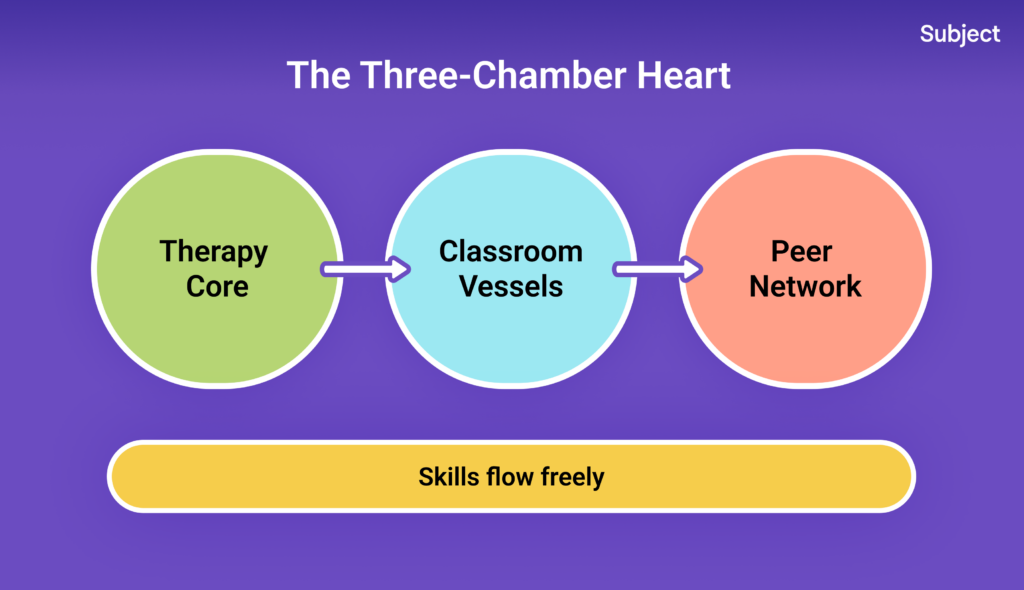
Traditional therapy operates like organs isolated for individual study. Speech happens in one room, academics in another, social skills in a third. Nothing connects.
But effective schools work like the circulatory system in our bodies. Skills developed in therapy must flow through every part of the school day, or they die in transit. Kind of like a beating heart, but instead of four chambers, the student is only flowing through three.
Here’s how Lucia uses her Three-Chamber strategy, the beating heart that keeps skills flowing freely between every room:
Chamber 1: The Therapy Core
Explicit instruction happens here using a clear skill hierarchy: isolation → words → sentences → oral reading → conversation. But this chamber requires transparent goal-setting from day one.
We know from Lucia’s confidence-first method that she refuses to use “right” and “wrong” with her students. She frames everything as “the new way” and “the old way.” Her data collection only marks pluses, never minuses. When a student needs support, she circles the plus.
Students track their own progress alongside her. They understand their goals, why those goals matter, and what success looks like.
Chamber 2: The Classroom Vessels
Skills practiced in therapy must reach classroom contexts where students can apply what they’ve learned and understand why it matters:
- Push-in support during academic instruction.
Lucia proactively coordinates times to work with students during their regular curriculum activities. “Push in the classroom when possible to support the whole class,” she says, “but also bring the student to my room for additional support. And of course, I do this after discussing with the teacher what time works best.” - Whole-class presentations that destigmatize differences.
When Lucia teaches an entire class, it normalizes support services. “It’s very funny, because then they all want to come to speech,” she shares. “They’re asking, ‘Ms. Donia, can you take me? I want to go to speech. Why don’t you take me?’”
Chamber 3: The Peer Network
Students become “little teachers themselves” when given consistent language and strategies.
“They’ll come up to tell me, ‘hey, Ms. Donia, this person was practicing their THs, and I heard that in class they said ‘math’ correctly,’” she recalls. It makes sense too. Students mirror the positive reinforcement they receive. So, when adults celebrate progress without judgment, kids do the same.
Cross-disciplinary collaboration amplifies this effect. Lucia runs social skills groups with the school psychologist and coordinates occupational therapy goals with sensory regulation strategies. They’ve developed a shared language that students use across all settings: “Refocus Lab,” “Zen Den,”and “new way versus old way.”
“I’m attaching language to the activities that [the occupational therapist is] working on, so we can use it and generalize it across settings,” she explains. “This way, we’re giving them the language to support what they need to focus on in the Refocus Lab or head over to the Zen Den.”
You’ll know your circulation system works when:
- Teachers proactively request resources before crises emerge
- Students use therapy language outside sessions unprompted
- Specialists share identical terminology schoolwide
- Skills appear in classroom assessments without direct prompting
Screen Time, Referrals, and the Rising Need
Educators across states report that young children are struggling with language development more than previous cohorts, with researchers pointing to increased screen time cutting down interaction between babies and caregivers.
For instance, children with two to four hours of daily screen exposure at age one are twice as likely to have communication delays by age two, and those with over four hours are five times more likely.
Lucia attributes the rise of screen time to the evident fact that families are now busier than ever with the state of the economy. Double-income households mean fewer adults home during the day. Parents work, grandparents work, and those laid-back dinnertime chats where kids learned to communicate have become rare.
While one solution is more therapy, Lucia says a smarter, more holistic approach is far more effective since it treats every adult interaction as a chance to model and reinforce communication skills. When the occupational therapist, speech therapist, and classroom teacher all use the same emotional regulation language, students don’t understand the cross-pollination of their skills.
Schools that figure this out now will be ahead as referrals continue climbing. Speech-language pathologist jobs are projected to grow 21% from 2021 to 2031, driven partly by increasing awareness of communication disorders and demographic shifts requiring more specialized cultural competency.
Your specialists already want to collaborate. They know the research, they see the outcomes, and they’re ready to work differently. But what they need is administrative support for shared planning time, protected push-in opportunities, and permission to prioritize coordination over paperwork.
Build the system where skills circulate freely between therapy rooms, classrooms, and peer interactions—because that student who reads a paragraph aloud in class is proving that when adults get their act together, kids flourish.