
Students trust a teacher who says “I don’t have all the answers.” Here’s how to build that kind of room
By the time most teachers get their own classroom keys, they’ve already spent about 13,000 hours watching other teachers work. Sociologist Dan Lortie added it all up in 1975 and called it the “apprenticeship of observation.” It’s the longest unpaid internship in America, and it comes with a side effect. Teachers tend to teach the way they were taught, and the pressure to get every lesson perfect comes along for the ride.
Diana Gebe and Ali del Castillo see this up close as instructional leaders at Tustin Unified School District, where they coach teachers and students. Diana has worked in education since 2003. Ali is a former high school English teacher. Both say a lot of that pressure starts with caring a whole lot.
“As educators, we want everything to be great and perfect,” Ali says.
Their advice starts with letting a lesson get a little messy.
Key takeaways:
- Teachers often teach the way they were taught after about 13,000 hours as students, which adds pressure to make every lesson perfect
- The Rerun Check helps teachers spot lessons copied from their own school days and rebuild them for the students in the room this year
- Teachers who share flopped lessons with colleagues and ask students “What did we learn?” make it safer for everyone to take risks
The pressure that comes from caring
Ask teachers where the pressure comes from and most will point to pass rates and admin walkthroughs. That pressure is real. In RAND’s 2026 survey, 55% of public school teachers reported frequent job stress, compared to 34% of similar working adults.
Ali and Diana add one more source to the list, and they include themselves in it.
“We kind of create a lot of the pressure that we feel ourselves,” Ali says. “We invent that a lot of the time.”
Some of it traces back to the classrooms teachers grew up in. Those 13,000 hours leave a mark, and a lesson that worked in 2003 can feel like the safe bet forever.
“We went through school one way and we’re recreating that experience, and it’s not necessarily benefiting the students in front of us,” Ali explains.
“Times aren’t what they were,” Diana says. When she started teaching, a school had one computer lab. Today, every Tustin student carries a school iPad or Chromebook, and Diana says they all have phones too.
The good news hides inside the tough news. Pressure that grows out of high standards is the part teachers control most. They can loosen it without waiting for a memo from the district office.
Give your lesson plans a remix
Diana and Ali don’t claim to have it all figured out. “If you crack the code, let us know,” Ali says. Their advice still fits into two tools teachers can try this week.
The first one comes courtesy of Dunder Mifflin. The American pilot of The Office was a near copy of the British original, and the show found its own voice in season two once the writers wrote for their own cast. Lessons deserve a season two as well.
Here’s how they run their Rerun Check:
1. Spot the rerun.
Flag the parts of a lesson that exist mostly because that’s how your own teachers did it. Some reruns are classics for a reason (hello, Friends).
2. Check the cast.
Picture who is in the room this year. Diana works with newcomers and students recovering credits, and she wants every one of them to feel success. “It’s important that all kids have access and can succeed and can find the self-confidence to believe in themselves,” she says.
3. Keep the book, change the job.
Ali uses George Orwell’s 1984 as an example. Students usually read it to recall the plot. Through a skills lens, they trace a character’s decisions and practice writing the way Orwell did. The book stays on the syllabus, and students do more of the thinking.
4. Air the new episode.
Teach the remix before it feels finished. Diana suggests a line any teacher can borrow. “I don’t have all the answers, but we can figure it out together.” She says a teacher who shows that kind of honesty gets students to trust them and open up too.
Roll the lesson blooper reels
The bloopers were always the real reason to buy The Office DVDs. Lesson bloopers deserve the same airtime. Ali wants more teachers sharing with their colleagues “how it went and how it may have floundered.” A flop shared at lunch can save the teacher next door from a rough Tuesday.
Teachers can fill out this card after a lesson goes sideways and bring it to their next team meeting.
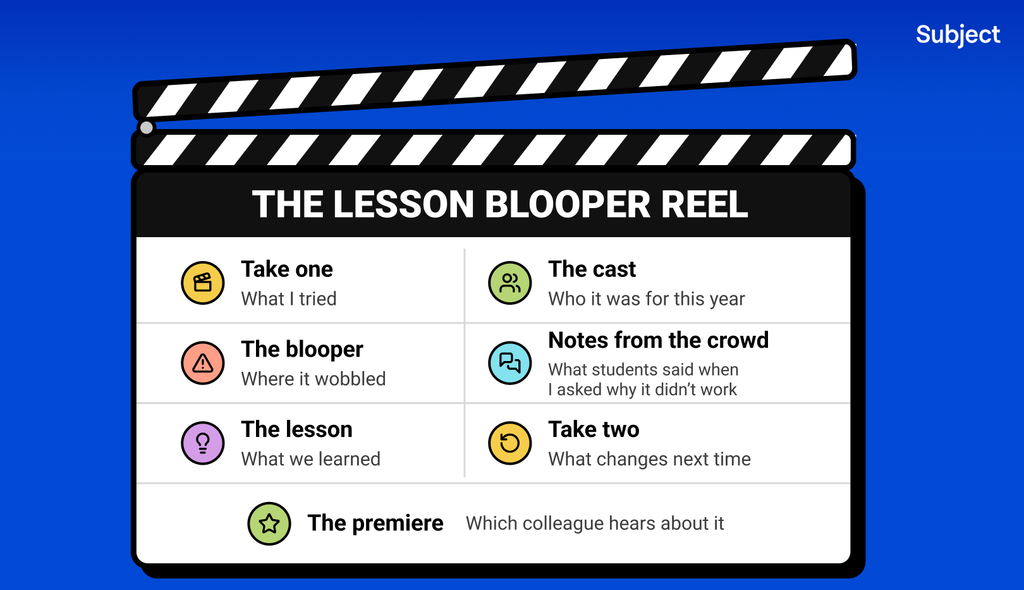
Ali also wants instructional leaders to partner with teachers who try something new, so teachers can invite a coach in for take two.
Students get a version of this, too. Diana’s first grader has a teacher who talks about risks constantly, so now her daughter comes home announcing, “Guess what I did today? I took a risk.” It flopped the first time, and she tried again anyway.
“It’s okay to fail,” Diana says. “What did we learn?”
Kids trust the teacher who tries
When Ali pictures school in 2035, she sees classrooms moving back toward skills-based learning, where students take what they know and use it across subjects. Research backs the messy middle part of that picture. In fact, analysis from ETH Zurich found that students who wrestle with a problem before they’re taught how to solve it tend to learn more, especially in secondary school.
That kind of struggle only works when trying feels safe, for students and teachers alike. Diana points out that kids keep changing, along with the devices in their backpacks.
“Our kids have changed, our times have changed and, until we as teachers and educators change with them, we’re always going to be behind,” she says.
At the end of their On the Subject episode, Subject co-founder and CEO Michael Vilardo asked both Diana and Ali to thank one student or teacher. Neither could pick just one. Both thanked every student who ever trusted them.
“It’s just been an honor and a privilege to allow them to trust me,” Diana says.
Ali feels the same way about any student who had “the confidence in me to guide them through whatever they were going through.”
That trust grows every time a teacher tries something new and lets the class watch the bloopers. Season two starts Monday.
FAQs
Why do teachers feel pressure to make every lesson perfect?
Teachers feel pressure to make every lesson perfect partly because they care so much about their students. Tustin Unified instructional leaders Diana Gebe and Ali del Castillo say some of that pressure also comes from recreating the classrooms teachers grew up in. Teachers can loosen that internal pressure themselves.
What is the apprenticeship of observation?
The apprenticeship of observation is sociologist Dan Lortie’s 1975 term for the roughly 13,000 hours future teachers spend watching their own teachers. Those hours shape how teachers teach later, so many teachers end up recreating the lessons they experienced as students.
How can teachers update old lessons for today’s students?
Teachers can update old lessons by keeping the content and changing what students do with it. Students reading 1984, for example, can trace a character’s decisions and practice writing like Orwell. The Rerun Check helps teachers plan for the students actually in the room this year.
Is it okay for a lesson to fail?
A failed lesson is okay and can even help students learn. A meta-analysis from ETH Zurich found that students who wrestle with a problem before instruction tend to learn more. Teachers who share flops with colleagues and ask “What did we learn?” model that same risk-taking.