
Three Questions Every Superintendent Should Ask Before Trusting a Virtual School Vendor
What to ask a vendor, what to ask yourself and where to go for proof that holds up
There are two questions people want to ask on a first date and usually don’t: what are you looking for, and are you going to be normal about it.
Vendor meetings run on an identical dynamic, minus the appetizers and flirting. District leaders sit across from a virtual school partner weighing exactly those same things while the conversation stays on implementation timelines.
Dylan Hoffman, our VP of Operations and Customer Success at Subject, would rather they just ask.
He’s guided dozens of districts through virtual program launches and fields the skepticism “all the time.” “It’s a departure from an oftentimes longstanding educational model,” he says. “It’s new. New can mean disruption.”
We’re here to cover the three questions every superintendent should ask a vendor directly, what a real answer sounds like and how to tell it apart from a rehearsed one.
Key takeaways:
- Superintendents should ask virtual school vendors about student competition and instructional quality before any pricing conversation begins.
- Trust stalls more virtual school programs than budget does, according to Subject VP of Operations and Customer Success Dylan Hoffman.
- In-state district references carry more weight than national client lists when evaluating a virtual school vendor.
Most decks answer the wrong question
Most vendor pitches are built to answer a question the superintendent hasn’t asked yet. The deck opens with product screenshots, moves to pricing tiers and closes with an implementation timeline, all of which assumes the hesitation in the room is about logistics. It’s the vendor equivalent of responding to “are you okay” with a spreadsheet.
Dylan’s experience says the hesitation usually lives somewhere deeper. “Is the quality of learning or the quality of instruction under duress? Is either going to go down?” he says, describing what district leaders weigh privately.
A district is accountable for instruction the way a pilot is accountable for landing, so handing part of that to an outside partner raises a real question about the controls. No cost breakdown addresses it.
The demand side of the equation is already settled. Nearly 29,000 Indiana students attended virtual K-12 schools in 2025, and that growth is being led by traditional public schools rather than outside operators. A district that never gets its trust questions answered usually stalls instead of declining, which costs the same students either way.
Ask these questions before you ask about price
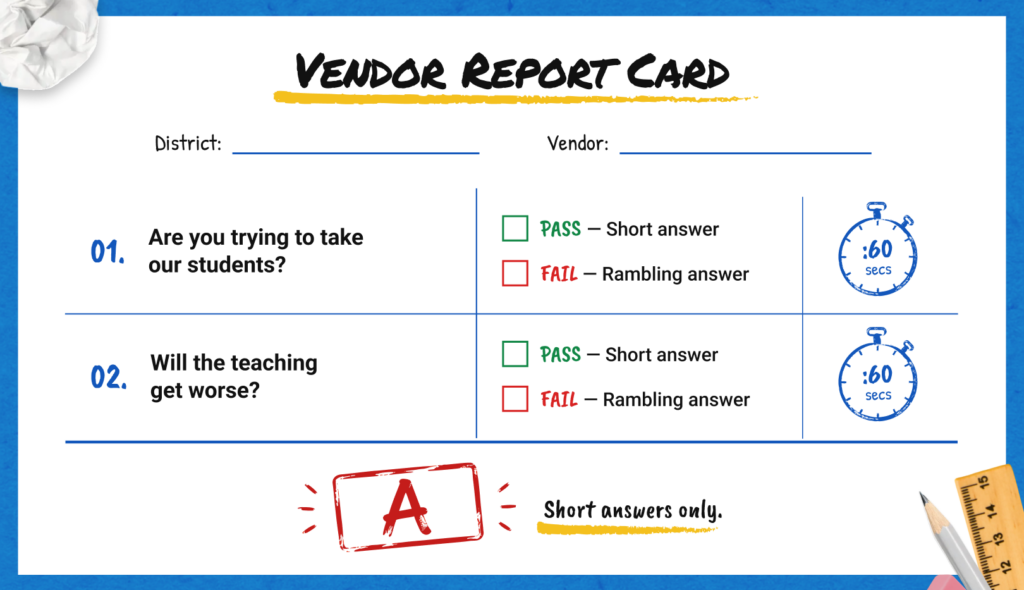
Two questions do most of the work in a vendor evaluation, and your real job during both is listening. Think of it as a pop quiz the vendor doesn’t know they’re taking, which is the best kind of pop quiz.
Here’s the rubric, plus one bonus third question and another worth asking yourself.
Question 1: “Are you trying to take our students?”
This is the existential one, the fear Dylan hears as “is Subject jockeying to become this virtual private school that’s going to take a bunch of our students and families?” Most people save it for meeting four, once the relationship feels safe enough. Meeting one is better. A few seconds of awkwardness buys you years of clarity.
- A dodge sounds like: a four-minute speech about shared values and partnership philosophy.
- A real answer sounds like: a flat no, followed by the business model that makes it true. Dylan’s version runs one sentence. “That’s not at all like our mission or what we’re trying to accomplish.” Then he moves on. Length is the tell. A vendor still talking at minute three is negotiating with itself.
Question 2: “Will the teaching get worse?”
Every vendor on earth will say no to this. The grading happens in the sixty seconds after.
- A dodge sounds like: the word rigorous, unaccompanied.
- A real answer sounds like: a description of the instructional model with tradeoffs named. Dylan answers with the design itself. “We’re a video-first platform, and we really, really believe in the power of short-form, bite-sized video content as an effective method of learning.” He gets specific about where the rigor lives. “Our curriculum is some of the most rigorous on the market from an online vendor standpoint. We incorporate a lot of open-ended work. We incorporate a lot of reading and writing.” A partner who can explain why the format looks the way it does has thought about your students (and can use the word “rigorous” with other words around it). A partner who can only reach for adjectives has only thought about your signature.
Question 3: “Who in my state can I call?”
Once the first two answers check out, ask for proof that answers to your state’s rules. Dylan puts evidence above anything his own team could say. “Don’t just take our word for it. Look at what’s going on here, here and here.” His bar is geographic. “That’s especially impactful when it’s intrastate.” A superintendent two counties over, working under your funding formula and your compliance calendar, tells you what a national logo wall never will. A reference from four states away is a LinkedIn endorsement, but a reference from your state is a witness
Now, the question to ask yourself: What year is my skepticism from?
Dylan meets people whose opening statement will be “online learning doesn’t work.” He takes it seriously. “There’s a pervasive jadedness around online learning and how ineffective it is,” he says, and he traces most of it to spring 2020, when districts stood up emergency remote school in about nine days with no budget, no playbook and a national laptop shortage. Anyone would carry scar tissue from that. Skepticism about that year and skepticism about the model are two separate objections, and integrity controls and curriculum design have moved considerably since. Worth knowing which one you’re holding before the meeting, because a vendor can’t sort that out for you.
Set the terms of the next conversation
The trust conversation isn’t wrapping up anytime soon, but it is headed somewhere with higher stakes. Dylan sees fully virtual programs as the opening act for blended models, where students move between the building and the platform depending on what they need that semester.
“If you can have students seamlessly move between the physical and the virtual environment… you start to unlock personalization, but it’s all done within the confines of like, there’s control, there’s oversight, there’s efficacy, there’s quality everywhere.”
Every word of that sentence answers the same two fears Dylan covered. The districts asking hard questions will set the terms of that next conversation instead of inheriting them.
The curriculum itself is moving too, “away from static courseware and more towards personalization, localization, adaptation… true adaptive learning,” as Dylan puts it.
Checklists of standards are giving way to core skills like critical thinking and synthesis, which means the quality question superintendents ask today will need re-asking in new forms for years.
None of this requires a leap of faith. Districts like Portage Township in Indiana have run this play for two years, kept their own teachers as teacher of record and recovered most of a year’s lost enrollment inside twelve months. Ask the three questions in the first meeting. The partners worth trusting have been waiting to answer them.
FAQs
Why do districts hesitate to launch virtual school programs?
Districts hesitate over trust rather than cost. Dylan Hoffman of Subject points to concerns about losing oversight, losing instructional quality and losing students to the vendor itself. Most vendor pitches answer logistics questions instead, so the real objection never gets addressed.
How can a district verify a virtual school vendor’s results?
A district should ask for a reference in its own state. Dylan Hoffman of Subject notes that in-state proof carries more weight because the reference district works under the same funding formula, compliance calendar and testing rules.
Is skepticism about online learning still justified after 2020?
Skepticism about 2020 and skepticism about virtual school today are separate objections. Emergency remote instruction ran without integrity controls or purpose-built curriculum. District leaders should ask vendors what has changed in both areas since then.