
The EdTech industry keeps spending billions trying to fix adoption. They’re solving the wrong problem.
Socrates got people to think by asking questions. Never used a dashboard or 14-step onboarding flow. Definitely no quarterly business review either.
He just showed up. Met people where they were and made them feel like their thinking mattered.
Thousands of years later, the $13 billion EdTech industry is still managing to miss that lesson.
Tim Clary has watched it happen up close.
He’s a former Division I walk-on football player at the University of Illinois, a classroom teacher who stepped in during COVID when schools needed bodies and stability. Oh, and he’s also a high school football coach who drove the bus home at 1 AM after away games.
As an Account Executive at Subject, Tim covers hundreds of schools in central Texas school districts. That combination (athlete, educator, coach, and vendor) gives him a read on schools that most people in EdTech simply don’t have.
Like why teacher adoption keeps failing—and what it actually takes to build something educators want to use.
Key Takeaways
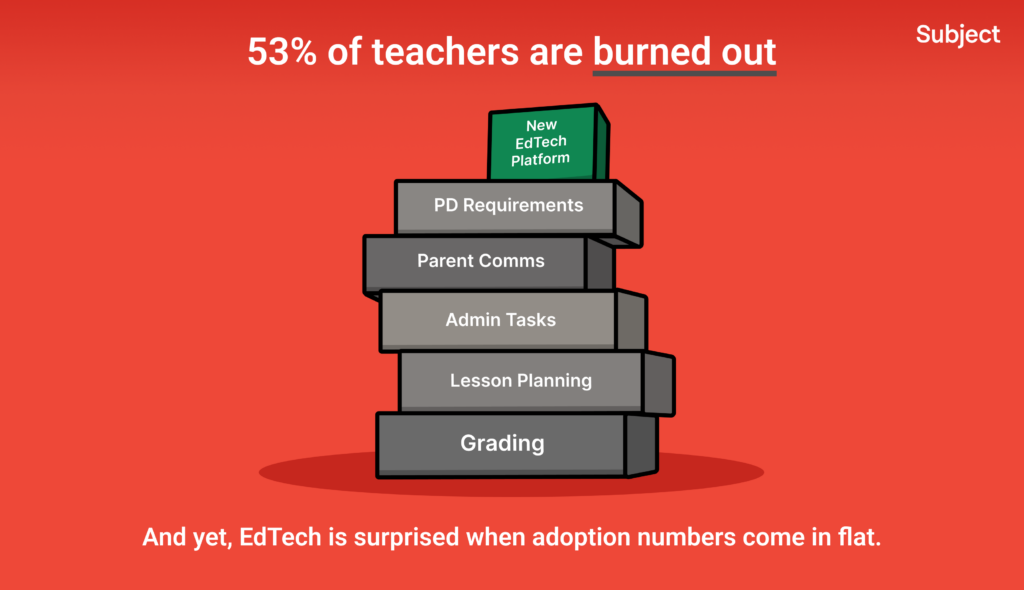
- Teachers aren’t resistant to technology, but they are overloaded. Every “new” platform adds to a pile that’s already too tall.
- EdTech adoption fails when companies design for purchase metrics instead of for the people who have to use the product daily.
- Treating teachers as partners, and not end users, is the most direct path to long-term trust, classroom use, and actual student outcomes.
EdTech’s favorite excuse
The “resistant teacher” is one of EdTech’s favorite myths.
Companies repeat it in product meetings, in pitch decks, and in post-mortem calls when adoption numbers come in flat. The logic goes: teachers are set in their ways, slow to change, probably a little afraid of technology. It’s a go-to explanation that’s tidy, self-serving, and wrong.
Especially when most EdTech vendors never had to take attendance while a kid’s crying in the back row and three others are on their phones. Which is why the industry’s favorite explanation for low adoption, aka the “resistant teacher” strikes Tim as a pretty convenient way to avoid looking in the mirror—and insulting.
“Teachers aren’t resistant to new EdTech because they’re not tech-savvy. They’re resistant because every new platform costs emotional energy.”
This has more to do with resource management than “resistance.” According to a 2025 RAND survey, 53% of teachers reported feeling burned out. Teachers are more than twice as likely as comparable working adults to experience frequent job-related stress. They’re working, on average, nearly ten hours more per week than their peers in other fields, and earn roughly $30,000 less in base salary.
So, asking them to relearn a new platform, rebuild their materials around it, and bet their students’ year on it is a significant ask. And with nearly 1 in 5 teachers considering leaving the profession entirely within the next four years, adding to educator burden instead of reducing it only accelerates the exact crisis EdTech claims to be solving.
Teachers are your partners, not your end users
Tim’s career has a common thread running from the Illinois football locker room to Central Texas school districts: make people feel seen, and everything else follows.
Lead with a pitch, and you just found the fastest way to lose a room.
He distilled a few principles that push back against EdTech’s go-to tactic of framing partnerships as a product feature instead of a relationship you have to earn.
Four ways to work with teachers, not at them
1. Earn trust before you ask for anything.
Tim doesn’t walk into a school district meeting with a pitch deck in hand and conversion goals top of mind. He walks in like someone who grew up around teachers (which he did, his mother was one!) and actually wants to understand what’s hard right now.
His goal when he first meets an administrator or teacher isn’t to explain why they need Subject. Like Socrates, he leads with questions—about what’s hard, what’s not working, what a normal Tuesday actually looks like. “Show up prepared, and be there to achieve their goals,” he says. “Not to close a deal.”
That sounds like a soft principle until you realize most companies do the exact opposite. And when a 2024 Auburn University study found that adding new platforms without removing old requirements actually INCREASED teacher burnout, the companies that lead with listening are the ones that avoid becoming one more thing on the pile.
2. Design for the full workload, not just the learning outcome.
A tool has to save teachers time and reduce mental load. It also has to improve student outcomes.
Both. Not one or the other. That’s two non-negotiables on the same checklist.
Most EdTech roadmaps prioritize the second and treat teacher workflow as a nice-to-have. Tim’s argument is that you can’t get the second without the first. A burned-out teacher working a second job on weekends is not in the headspace to implement a brand-new platform with fidelity. The product has to reduce friction to allow the teacher to create any real results.
This is also why so many EdTech implementations look great on paper and fall apart in practice. With 68% of teachers citing workload as the main driver of their stress, any product that ignores that number during the design process is building on sand.
3. Become a champion for teachers.
Tim posts on LinkedIn about teacher pay.
He once shared his actual offer letter from his first teaching job ($46,000) circled the number and made the case for why it was wrong. He meant it, too.
His point comes down to this: ask any stranger on the street who their most influential teacher was, and they’ll know the name.
When an occupation carries that kind of weight, the pay—and the respect—should reflect it.
For EdTech companies, this principle plays out practically. How you talk about teachers in your content, in your product, and in your pitch tells educators exactly how much you respect them.
Companies that treat teacher adoption as a friction problem, like it’s something to engineer around. Those that publicly acknowledge what teaching actually costs, in time and energy and salary, signal something very different and far more trusting.
4. Understand that struggling students and struggling teachers have the same core need.
Tim’s best football coaching insight wasn’t about X’s and O’s.
It was about psychological safety—creating an environment where students knew the standard was high because the support behind it was even higher. Athletes on his team knew they could ask for help without being judged for it. That combination of high expectation and genuine support is what made the difference.
He carries that same logic directly into his work in EdTech. Teachers will accept an imperfect product. They’ll work through a rough onboarding. They’ll give a new platform a real shot, but only if they believe the relationship behind it is genuine. What they’re looking for isn’t perfection, but demands that are far more realistic: authenticity, real support, and relevance to the actual work they’re doing.
Education won’t wait for EdTech to figure this out
At last count, more than 411,000 teaching positions were either unfilled, or filled by someone not fully certified for the role. Roughly 1 in 8 positions nationally.
And that number is going up, not down.
The companies that keep treating teachers as obstacles to adoption rather than the whole point of the enterprise are not going to fare well in the environment that’s coming.
Tim doesn’t seem to panic, because he sees it with the same clarity he’s always operated by: education is the foundation of the country, and without an educated population, everything else stalls.
The EdTech industry sits at a fork.
One path keeps doing what it’s been doing: selling to administrators, onboarding grudgingly, and blaming teachers when numbers don’t move. The other path starts with the actual people doing the work: showing up prepared, listening first, building products that make Monday morning easier instead of harder, and earning the right to be in those classrooms over time.
The districts are watching. The teachers are deciding. The companies that understand education will always be a human-centered profession—and act like it—are the ones worth betting on. And the teachers, the ones carrying 50-hour weeks and still showing up for their kids every morning, are the ones who’ll decide which companies those are.
FAQs
What’s the most common mistake EdTech companies make when pitching to schools?
Treating teacher concerns as objections to overcome rather than information to actually absorb. Teachers signal exactly what they need through the questions they ask and the hesitations they express. The companies that listen to those signals build better products and longer relationships.
How do you build trust with educators quickly?
Show up knowing something about their world before you start talking about yours. Know what the schedule looks like, what the staffing pressures are, and what they’ve already tried. Preparation signals respect, and respect is where trust starts.
Does being a former teacher actually matter in EdTech sales?
It matters less as a credential and more as a perspective. The point isn’t to name-drop classroom experience, but to genuinely understand that the person on the other side of the table is managing an enormous amount, and that your job is to reduce their load, not add to it.